
Key Takeaway
Induced mouth breathing in young primates led to significant changes in facial development, supporting the theory that breathing mode affects craniofacial growth.
Summary
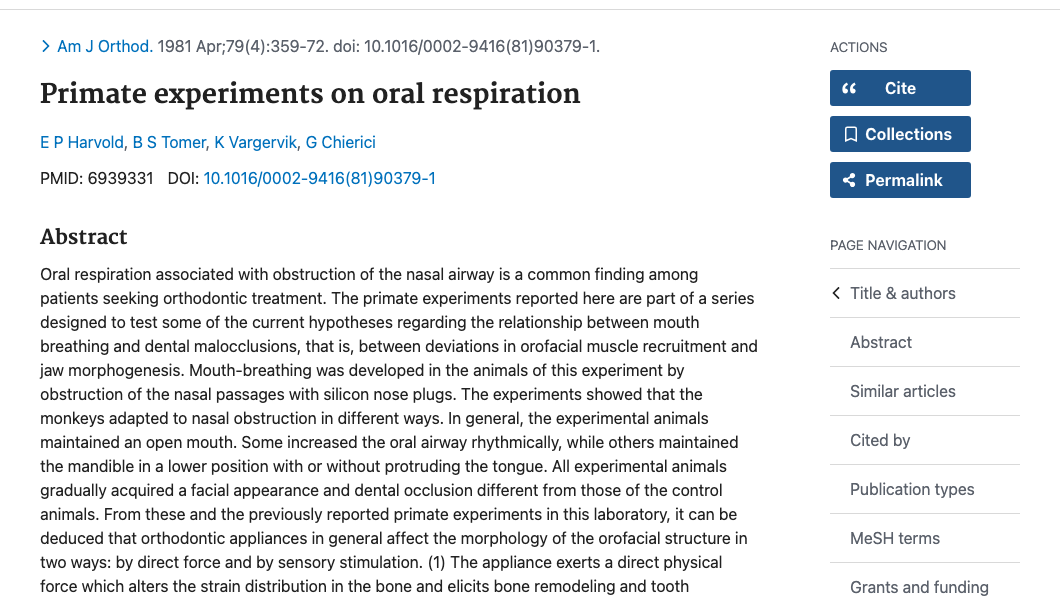
This landmark study experimentally tested whether mouth breathing affects facial development by inducing obligate oral breathing in young rhesus monkeys.
Study Design:
- Young rhesus monkeys (growing animals)
- Nasal obstruction induced via silicone nose plugs
- Forced obligate mouth breathing
- Compared to control animals (nasal breathing)
- Monitored over growth period
Key Findings:
| Change | Mouth Breathers |
|---|---|
| Face length | Increased (longer face) |
| Mandible | More downward growth |
| Palate | Narrower, higher arch |
| Dental arch | Narrower |
| Head posture | Extended (forward) |
Observed Changes:
- "Long face syndrome" development
- Lowered tongue posture
- Altered muscle function
- Narrower maxilla
- Increased facial height
Mechanism:
When nasal breathing is blocked: 1. Tongue drops to allow oral breathing 2. Loss of tongue pressure on palate 3. Cheek pressure unopposed 4. Face grows downward and narrower 5. "Adenoid facies" pattern develops
Relevance to Mewing:
This study provides foundational evidence that: - Breathing mode affects facial development - Tongue position (influenced by breathing) shapes the palate - Changes occur during growth periods
Limitations:
- Animal study (primates, not humans)
- Extreme intervention (complete obstruction)
- May not directly translate to human outcomes
- Studied growing animals, not adults
Clinical Significance:
Supports the principle that oral posture and breathing mode influence craniofacial development, though the study used extreme interventions in growing animals.