
Key Takeaway
Systematic review of 11 strongman studies finds farmer's walk performance is driven by greater stride length, stride rate, and reduced ground contact time, with clear applications for athletic and occupational conditioning.
Summary
This systematic review analyzed 11 studies on the biomechanics of strongman exercises including the farmer's walk, heavy sled pull, tire flip, Atlas stone lift, and log lift.
The review identified key biomechanical performance determinants for each exercise. For the farmer's walk specifically, higher-performing athletes demonstrated greater stride length, stride rate, and reduced ground contact time compared to lower-performing athletes. The carrying events challenged different physical abilities than traditional lifting events, suggesting loaded carries complement rather than duplicate standard resistance training.
The authors highlight the applicability of strongman exercises beyond competition, noting relevance for strength and conditioning coaches, tactical operators (military, law enforcement), and manual labor occupations where loaded carrying is a core physical demand.
Methods
- Systematic search of PubMed, SPORTDiscus, and Google Scholar
- 11 studies met inclusion criteria
- Biomechanical variables extracted and analyzed
- Performance determinants identified for each exercise type
Key Results
- Higher farmer's walk performance linked to greater stride length and rate
- Reduced ground contact time distinguishes faster performers
- Carrying events challenge different abilities than lifting events
- Strongman exercises produce unique biomechanical demands
- Applicable to athletic, military, and occupational populations
Figures
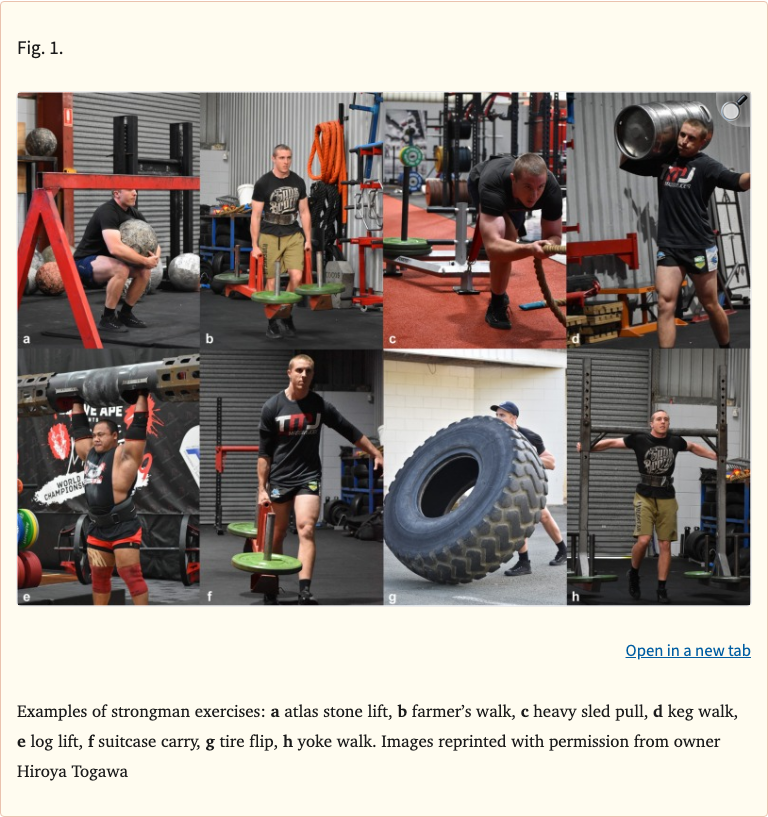 Figure 1
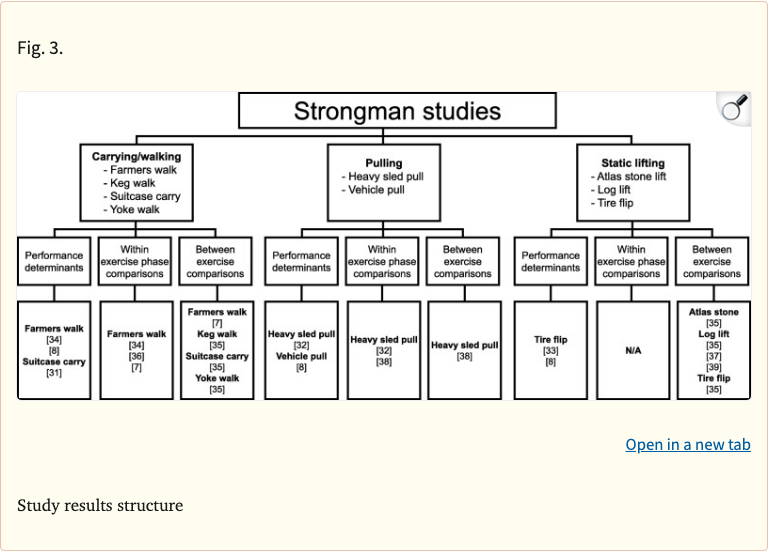 Figure 2
Limitations
- Limited number of studies available (only 11 met criteria)
- Heterogeneous methodologies across studies
- Most studies used competitive strongman athletes
- Lack of longitudinal training adaptation data
- Few studies on injury risk or prevention