
Key Takeaway
EMG analysis shows the farmer's walk significantly activates the gluteus medius, especially in individuals with weaker hip abductors relative to thigh muscles, making it an effective hip stabilizer exercise.
Summary
This study examined muscle activation patterns during the farmer's walk, specifically the relationship between hip abductor-to-thigh muscle strength ratios and electromyography (EMG) amplitude.
Sixteen resistance-trained men performed maximal isometric contractions followed by farmer's walk sets at 75% of their 6-rep max. EMG data was collected from the vastus medialis, vastus lateralis, biceps femoris, and gluteus medius on each leg during the loaded carry.
The key finding was that individuals with lower hip abduction-to-thigh strength ratios (HAB/H < 1 and HAB/Q < 0.5) showed greater gluteus medius activation during the farmer's walk. This suggests the exercise naturally targets hip stability weaknesses, making it a practical choice for strengthening the gluteus medius without needing isolation exercises.
Methods
- 16 resistance-trained males
- Maximal isometric contractions measured first
- Farmer's walk performed at 75% of 6RM
- Surface EMG on vastus medialis, vastus lateralis, biceps femoris, gluteus medius
- Strength ratios calculated (HAB/H, HAB/Q)
Key Results
- Participants with HAB/H < 1 had greater gluteus medius activation
- Participants with HAB/Q < 0.5 also showed higher glute med EMG
- Farmer's walk recruits gluteus medius as a primary stabilizer
- Thigh muscle activation was consistent across strength ratio groups
- Exercise recommended for hip abductor strengthening
Figures
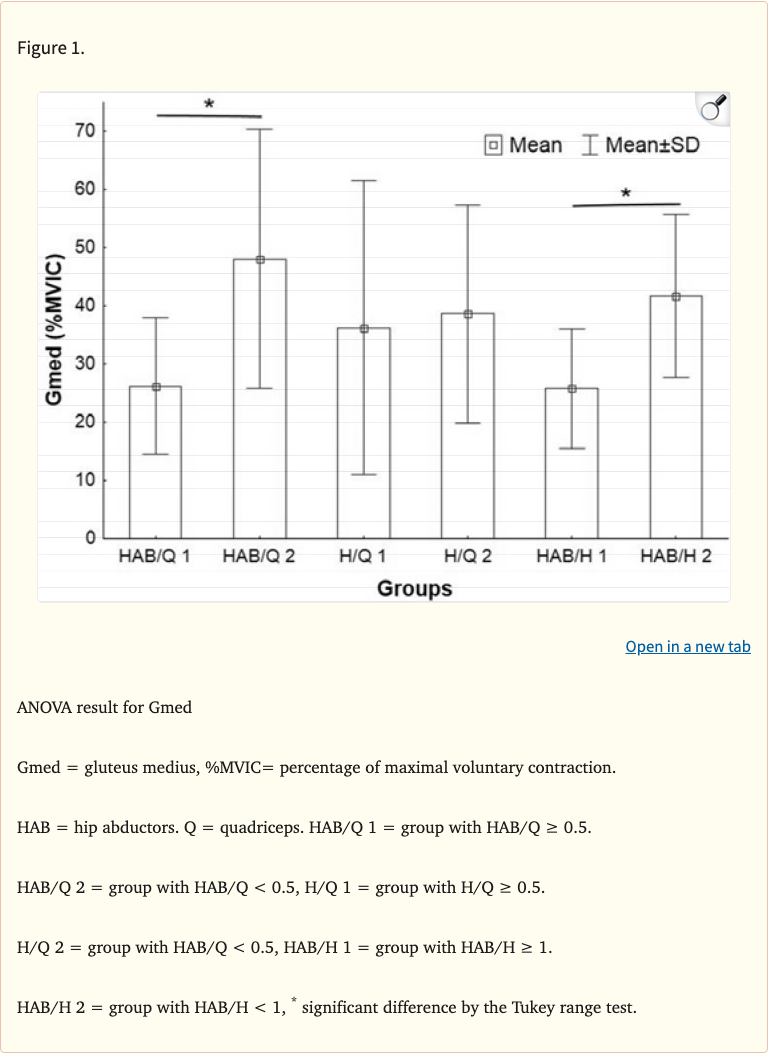 Figure 1
Limitations
- Small sample size (n=16)
- Only resistance-trained males tested
- Single loading condition (75% 6RM)
- No longitudinal training outcomes measured
- Did not examine other carry variations (suitcase, overhead)