
Key Takeaway
Activated charcoal remains the primary GI decontamination method after acute overdose, but evidence supports use mainly within 1-2 hours of ingestion and effectiveness varies by substance.
Summary
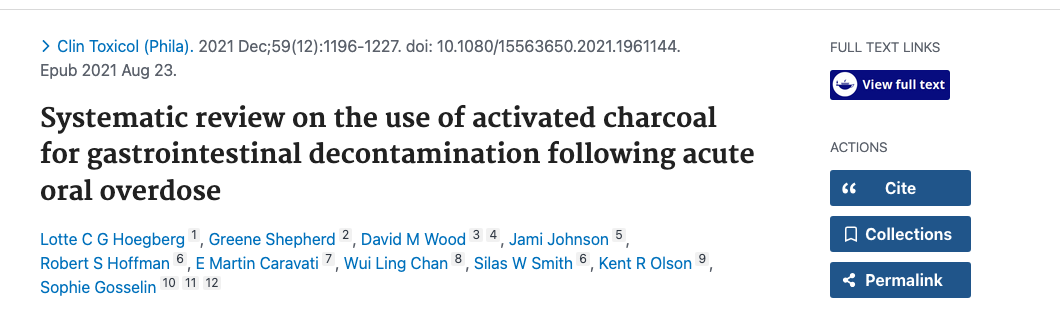
This systematic review evaluated the clinical evidence for activated charcoal as a gastrointestinal decontamination strategy following acute oral overdose. The authors examined studies on single-dose activated charcoal (SDAC) and multiple-dose activated charcoal (MDAC) across various poisoning scenarios.
The review confirmed that activated charcoal is most effective when administered within 1 hour of ingestion, with declining benefit thereafter. MDAC may enhance elimination of certain drugs with enterohepatic circulation or slow-release formulations. The authors found that while charcoal remains the most widely used decontamination method, routine administration without clinical indication is not supported.
The paper provides updated guidance on patient selection, timing, dosing, and contraindications, reinforcing that activated charcoal should be used selectively rather than as a blanket intervention in overdose management.
Methods
- Systematic review of clinical trials, observational studies, and volunteer studies
- Evaluated both single-dose and multiple-dose activated charcoal protocols
- Assessed timing of administration relative to ingestion
- Reviewed substance-specific effectiveness data
Key Results
- Greatest reduction in drug absorption when charcoal given within 1 hour of ingestion
- SDAC reduced absorption by approximately 50-70% when given within 1 hour
- MDAC shown beneficial for specific substances (e.g., carbamazepine, dapsone, theophylline)
- Effectiveness declines substantially beyond the 1-2 hour window
- No consistent evidence supporting routine use in all overdose presentations
Limitations
- Many included studies were volunteer studies with controlled doses, not real overdose patients
- Heterogeneity in substances, doses, and timing across studies
- Ethical constraints limit randomized controlled trials in acute poisoning
- Limited evidence for many specific substances