
Key Takeaway
BFR training is effective for rehabilitation, reducing muscle atrophy and accelerating strength recovery post-injury or surgery.
Summary
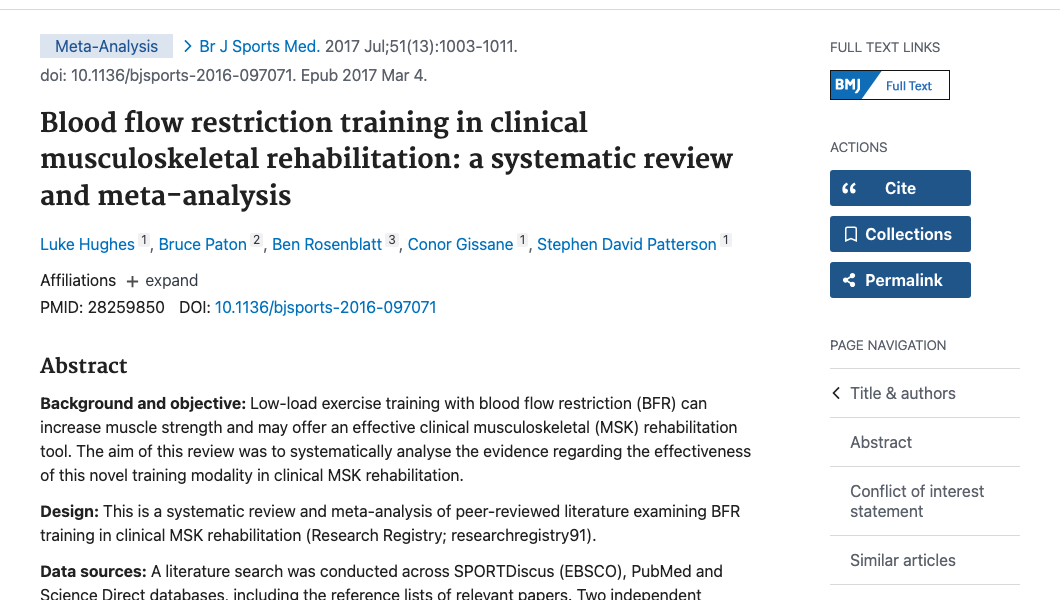
This systematic review examined the use of blood flow restriction training in clinical rehabilitation settings, including post-surgical recovery (ACL reconstruction, knee replacement) and various musculoskeletal conditions.
The analysis found that BFR training significantly reduced muscle atrophy and weakness during rehabilitation periods. Patients using BFR showed faster return of muscle function compared to standard low-load rehabilitation alone.
The findings support BFR as a valuable tool for physical therapists and rehabilitation specialists, particularly when patients cannot tolerate high mechanical loads.
Methods
- Systematic review of clinical rehabilitation studies
- Included post-surgical and injury rehabilitation
- Analyzed muscle size and strength outcomes
- Assessed safety in clinical populations
Key Results
- Reduced muscle atrophy post-surgery
- Faster strength recovery
- Safe in rehabilitation populations
- Effective with very low loads (20-30% 1RM)
Limitations
- Heterogeneous patient populations
- Varied rehabilitation protocols
- Limited long-term follow-up
- More high-quality RCTs needed
Related Interventions
Related Studies
Discussed In

Improving Science & Restoring Trust in Public Health | Dr. Jay Bhattacharya
Huberman Lab

Build Muscle Using Blood Flow Restriction (BFR Training for Lifters Over 40) | Ep 239
Wits & Weights | Evidence-Based Fitness & Nutrition for Lifters Over 40

Ep. #443: Does Blood Flow Restriction (Occlusion) Training Really Work?
Muscle for Life with Mike Matthews

SS 139 - Occlusion Training... Silly or Science?
Strength & Scotch: Get Fitter While Enjoying Life

Ep. #237: Research Review: Dr. Mike Zourdos on Blood Flow Restriction Training
Muscle for Life with Mike Matthews

S2 Ep. 46: Everything You Need to Know About Blood Flow Restriction Training, Tips on Injury-Proofing, and a Hint of Financial Fitness with Dr. Zachary Long
better. with Jerred Moon

Blood Flow Restriction Training
Pediatric Sports Medicine Podcast