
Key Takeaway
Exogenous BHB supplementation raised blood ketone levels but did not improve walking economy, energy expenditure, or perceived exertion in healthy non-trained adults.
Summary
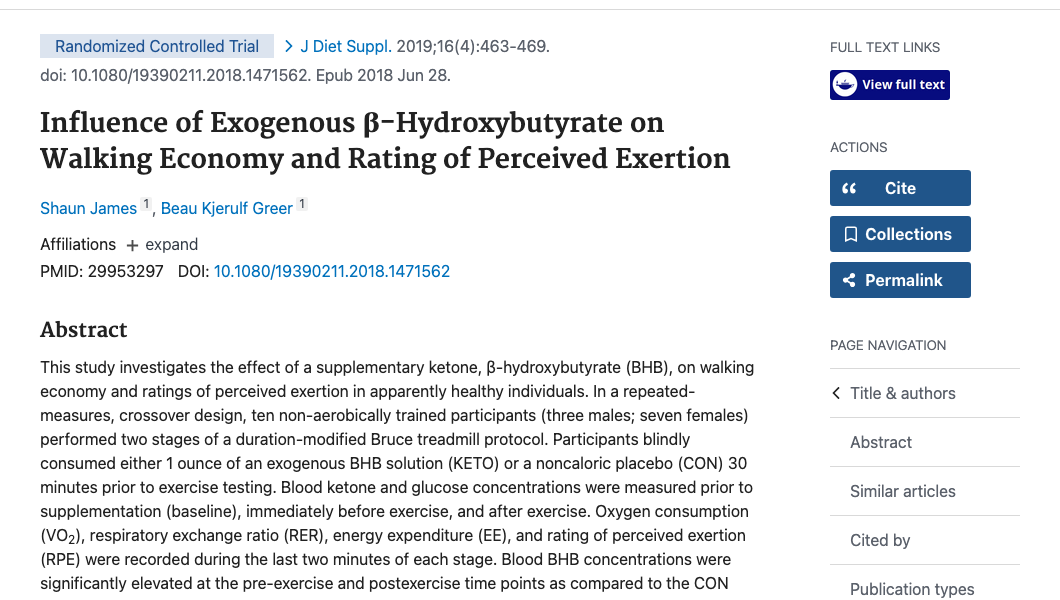
This randomized, crossover trial examined whether acute ingestion of exogenous beta-hydroxybutyrate (BHB) could improve exercise economy and reduce perceived exertion during submaximal treadmill walking. Ten non-aerobically trained participants (3 male, 7 female) consumed either 1 ounce of BHB solution or a placebo 30 minutes before completing two stages of a modified Bruce treadmill protocol.
Blood BHB concentrations were significantly elevated at both pre-exercise and post-exercise time points in the ketone condition compared to placebo, confirming the supplement successfully raised circulating ketone levels. However, despite this elevation in blood ketones, there were no significant differences between conditions for oxygen consumption, respiratory exchange ratio, energy expenditure, or rating of perceived exertion.
The findings suggest that while exogenous BHB reliably increases blood ketone availability, this does not automatically translate to improved exercise efficiency or reduced effort perception in untrained individuals performing moderate-intensity exercise. The authors concluded there was no evidence of an ergogenic benefit from BHB supplementation in this healthy, non-athlete population.
Methods
- Randomized crossover design with 10 non-aerobically trained participants (3 male, 7 female)
- Two conditions: 1 oz exogenous BHB solution vs placebo, consumed 30 min before exercise
- Modified Bruce treadmill protocol (two stages of graded walking)
- Blood ketone and glucose measured at baseline, pre-exercise, and post-exercise
- Oxygen consumption, respiratory exchange ratio, energy expenditure, and RPE recorded during final 2 minutes of each stage
Key Results
- Blood BHB was significantly elevated pre-exercise and post-exercise vs placebo
- No significant difference in oxygen consumption between conditions
- No significant difference in respiratory exchange ratio
- No significant difference in energy expenditure
- No significant difference in rating of perceived exertion (RPE)
- Blood glucose was not significantly different between conditions
Limitations
- Small sample size (n=10)
- Non-aerobically trained participants limit generalizability to athletes
- Single low dose of BHB (1 oz) may have been insufficient
- Only submaximal walking was tested, not higher-intensity or endurance exercise
- Short exercise protocol may not capture effects seen during prolonged exertion
- Crossover design limited to acute supplementation only