Key Takeaway
A comprehensive review finds that regular sauna bathing is associated with reduced risk of cardiovascular disease, neurocognitive disease, pulmonary conditions, and all-cause mortality, with benefits following a dose-response pattern.
Summary
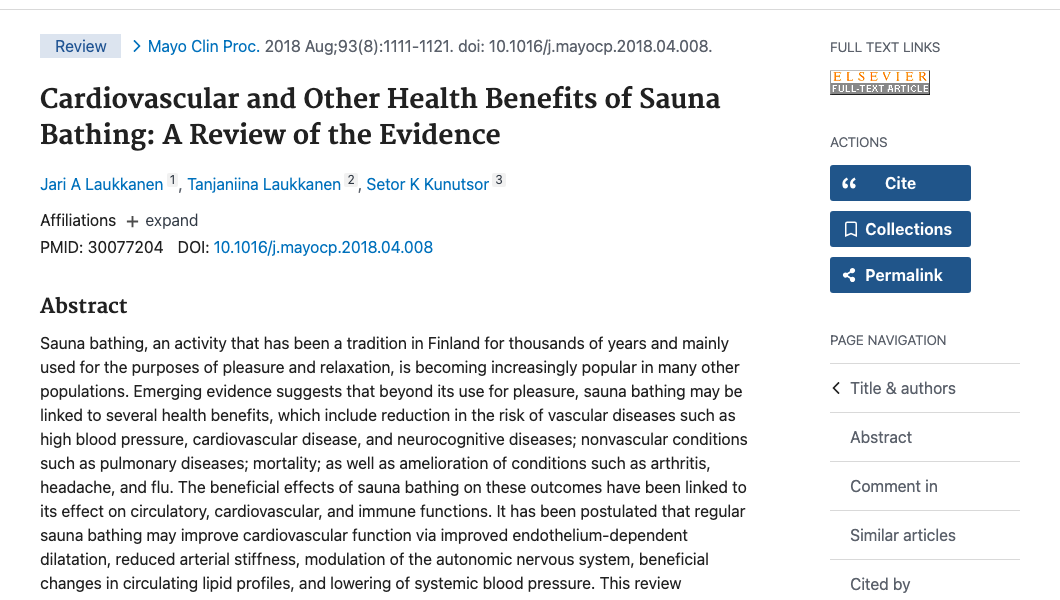
This review by Laukkanen, Laukkanen, and Kunutsor provided a comprehensive overview of the health benefits of sauna bathing, drawing primarily from their extensive research program using the Kuopio Ischaemic Heart Disease (KIHD) Risk Factor Study cohort. The review covered cardiovascular, neurological, pulmonary, and mortality outcomes associated with regular Finnish sauna use.
The authors detailed the physiological responses to sauna bathing, which include increased heart rate (up to 100-150 bpm), elevated cardiac output, redistribution of blood flow to the skin, sweating-induced fluid loss, and activation of neurohormonal pathways including growth hormone release and reduced sympathetic nervous system activity. These acute responses produce adaptations similar to those seen with moderate-intensity exercise, particularly improvements in endothelial function, arterial compliance, and blood pressure regulation.
Key epidemiological findings highlighted in the review include dose-response reductions in fatal cardiovascular disease (up to 50% for 4-7 sessions/week vs 1/week), all-cause mortality (40% reduction), dementia risk (65% reduction), and sudden cardiac death (63% reduction). The review also noted emerging evidence for benefits in chronic pain, respiratory conditions, and inflammatory markers. The authors concluded that sauna bathing is a safe practice for most healthy adults and even for stable cardiac patients, though they acknowledged that the predominantly observational evidence base limits causal inference.
Methods
Narrative review synthesizing evidence from epidemiological studies, clinical trials, and mechanistic research on sauna bathing and health outcomes. Primary evidence base was the KIHD Risk Factor Study (2,327 middle-aged Finnish men, median 20+ years follow-up), supplemented by clinical studies on acute physiological responses and interventional studies in patients with cardiovascular conditions.
Key Results
- Fatal cardiovascular disease risk: 27% lower (2-3 sessions/week) and 50% lower (4-7 sessions/week) vs 1 session/week.
- Sudden cardiac death: 22% lower (2-3x/week) and 63% lower (4-7x/week) vs 1x/week.
- All-cause mortality: 24% lower (2-3x/week) and 40% lower (4-7x/week) vs 1x/week.
- Dementia risk: 22% lower (2-3x/week) and 65% lower (4-7x/week) vs 1x/week.
- Alzheimer's disease: 20% lower (2-3x/week) and 65% lower (4-7x/week) vs 1x/week.
- Longer sauna sessions (>19 min) were associated with greater risk reductions than shorter sessions (<11 min).
- Acute physiological effects: heart rate 100-150 bpm, blood pressure reduction post-session, increased growth hormone.
- Safe for stable heart failure patients; improved NYHA functional class and exercise capacity in clinical trials.
Limitations
- Most epidemiological evidence is from a single Finnish male cohort, limiting generalizability.
- Observational design cannot establish causation; healthy user bias is a concern.
- Limited data on women, younger populations, and non-Finnish sauna traditions.
- Infrared sauna evidence is less robust than traditional Finnish sauna evidence.
- Confounding by other healthy behaviors not fully accounted for.
- Lack of large-scale randomized controlled trials on long-term health outcomes.
Related Interventions
Related Studies
More by Laukkanen
Discussed In