
Key Takeaway
40-minute percussion massage therapy was more effective than static stretching for DOMS recovery, significantly reducing pain and improving jump performance and knee ROM at 48 hours
Summary
This randomized controlled trial compared percussion massage therapy (PMT) at two durations against static stretching for recovery from delayed onset muscle soreness (DOMS) in 30 physically active male college students. Participants were divided into three groups of 10: static stretching (SS), short-duration PMT (25 minutes), and long-duration PMT (40 minutes). DOMS was induced via 10 sets of 7 back squats at 60% 1RM with controlled 4-second tempo.
Treatments were applied twice: immediately after the DOMS protocol and again at 24 hours. The percussion device (OUTSO 06 fascia gun) operated at 53 Hz with 6 mm amplitude using a soft head attachment. Researchers measured VAS pain, knee ROM, countermovement jump performance (height, peak ground reaction force, propulsion impulse), and EMG activity of the quadriceps at baseline, post-DOMS, post-treatment, 24 hours, and 48 hours.
At the critical 48-hour timepoint, the long-duration PMT group showed markedly superior outcomes compared to static stretching: significantly lower VAS pain scores (p = 0.003, d = -1.53), greater knee ROM (p = 0.012, d = -4.77), higher jump height (p < 0.001, d = 8.69), greater peak ground reaction force (p < 0.001, d = 19.17), and higher propulsion impulse (p < 0.001, d = 8.30). The long-duration group also outperformed the short-duration group on jump metrics. Importantly, the long-duration PMT group showed significantly lower normalized EMG activation across all three quadriceps muscles at 48 hours, suggesting more efficient muscle function and reduced compensatory motor unit recruitment.
The study concluded that PMT was more effective than static stretching for DOMS recovery, with 40-minute sessions providing superior benefits to 25-minute sessions. Limitations include the male-only sample, single percussion frequency tested, and the use of only one device type.
Methods
- Randomized controlled trial with 30 physically active male college students
- 3 groups (n=10 each): static stretching, short PMT (25 min), long PMT (40 min)
- DOMS protocol: 10 sets of 7 back squats at 60% 1RM with 4-second controlled tempo
- Device: OUTSO 06 fascia gun at 53 Hz, 6 mm amplitude, 5 cm soft head
- Short PMT: 2.5 min per muscle site (25 min total)
- Long PMT: 4 min per muscle site (40 min total)
- Treatments applied twice: immediately post-DOMS and at 24 hours
- Outcomes: VAS pain, knee ROM, CMJ (height, peak GRF, propulsion impulse), EMG
- Measured at 5 timepoints: baseline, post-DOMS, post-treatment, 24h, 48h
Key Results
- At 48h, long PMT had significantly lower VAS pain than SS (p = 0.003, d = -1.53)
- At 48h, long PMT had greater knee ROM than SS (p = 0.012, d = -4.77)
- At 48h, long PMT had higher CMJ jump height than SS (p < 0.001, d = 8.69) and short PMT (p = 0.006, d = 4.37)
- At 48h, long PMT peak GRF superior to SS (p < 0.001, d = 19.17) and short PMT (p < 0.001, d = 14.33)
- At 48h, long PMT propulsion impulse better than SS (p < 0.001, d = 8.30) and short PMT (p = 0.003, d = 4.52)
- At 48h, long PMT showed significantly lower normalized EMG across all 3 quadriceps muscles vs both groups (all p < 0.001)
- Short PMT showed some improvements over SS but was inferior to long PMT on most jump metrics
Figures
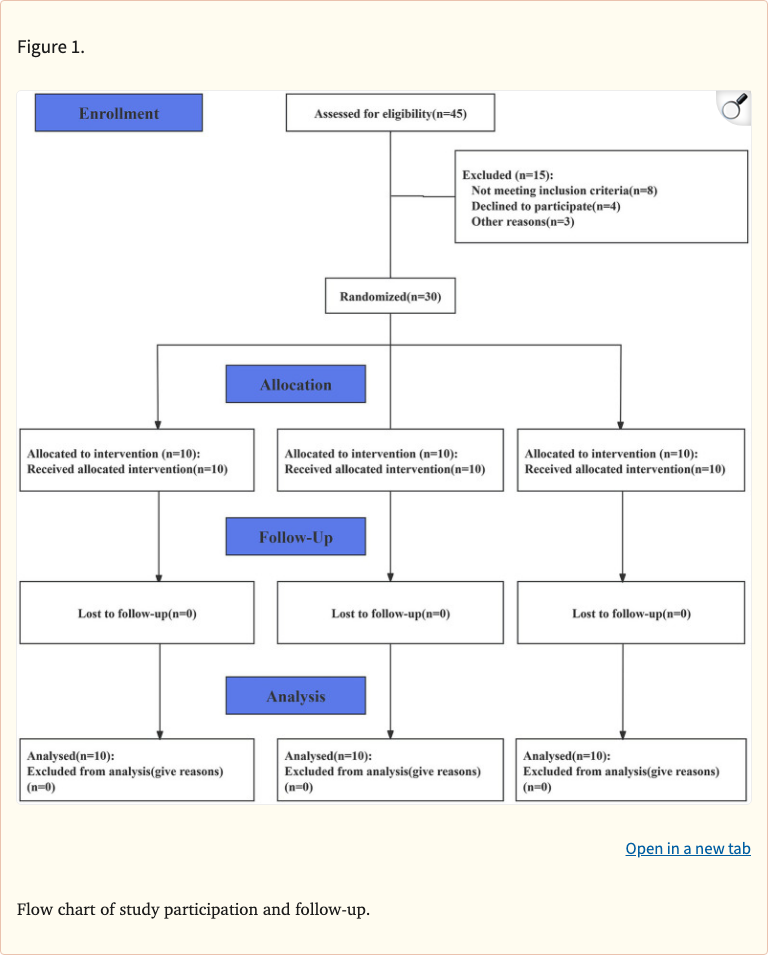 Figure 1
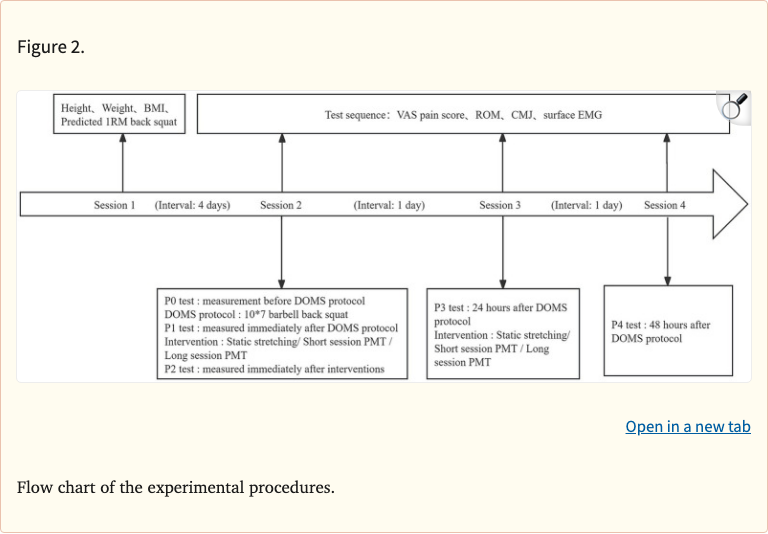 Figure 2
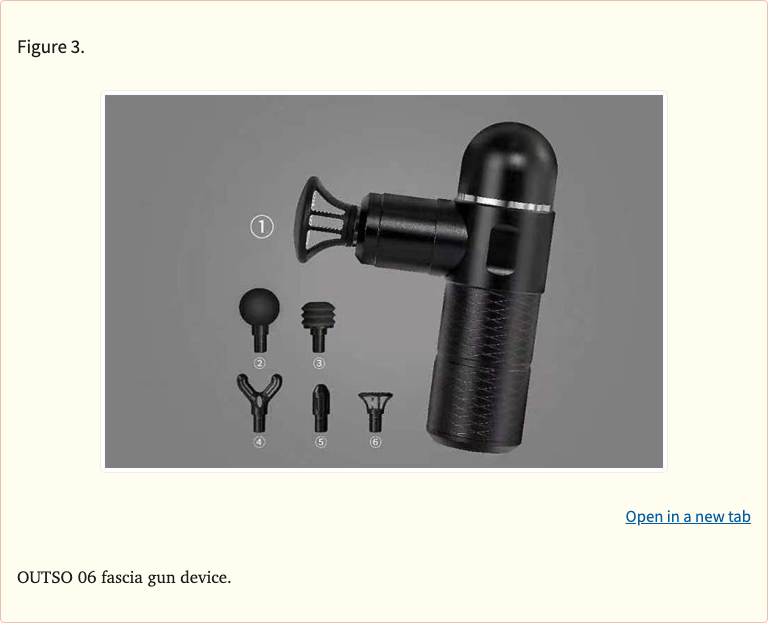 Figure 3
Limitations
- Male-only sample limits generalizability to female populations
- Single vibration frequency (53 Hz) tested; other frequencies not compared
- Only one device type used; different massage heads not compared
- Small sample size (n=10 per group)
- Case reports of rhabdomyolysis with PMT noted (though no injuries observed in study)
- Short follow-up period (48 hours maximum)