
Key Takeaway
Contrast water immersion (alternating 36°C and 12°C) accelerated plasma lactate clearance by 27% compared to passive recovery after intense anaerobic exercise.
Summary
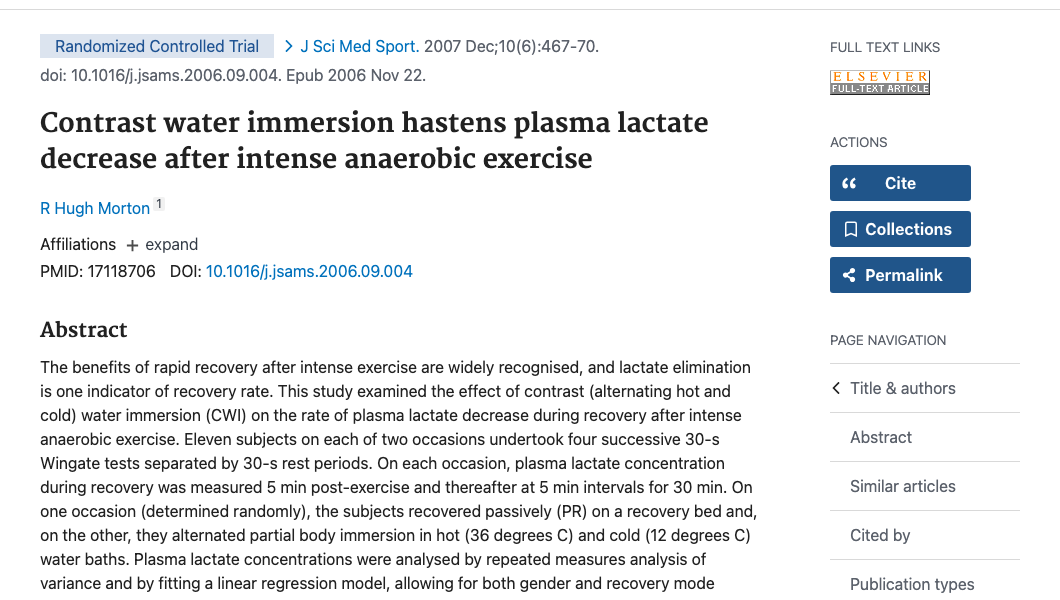
This RCT tested the physiological mechanism behind contrast therapy's recovery benefits. 11 subjects performed four successive 30-second Wingate anaerobic tests, then recovered with either contrast water immersion (alternating between 36°C hot and 12°C cold baths) or passive rest on a bed. Plasma lactate was measured at 5-minute intervals for 30 minutes.
Contrast immersion cleared lactate significantly faster: 0.28 mmol/L/min vs 0.22 mmol/L/min for passive recovery — a 27% improvement. After 30 minutes, this translated to a 1.8 mmol/L difference between conditions. No gender differences were observed.
The authors note that a 1.8 mmol/L advantage may be practically significant given that competitive margins among elite athletes are often 1-2%. This study provides direct physiological evidence for the "vascular pump" mechanism — alternating vasodilation and vasoconstriction driving faster metabolite clearance.
Methods
- 11 subjects (male and female), randomized crossover
- 4 x 30-second Wingate anaerobic tests with 30-second rest intervals
- Contrast immersion: alternating 36°C (hot) and 12°C (cold) water baths
- Control: passive recovery on a bed
- Plasma lactate at 5-min intervals for 30 minutes post-exercise
Key Results
- Contrast lactate clearance: 0.28 ± 0.02 mmol/L/min
- Passive clearance: 0.22 ± 0.02 mmol/L/min (p<0.001)
- 1.8 mmol/L difference after 30 minutes
- No gender differences observed
Limitations
- Small sample (n=11)
- Only measured lactate — not other recovery markers
- Anaerobic protocol may not generalize to endurance or strength training recovery