Key Takeaway
Resistance training is associated with significantly lower all-cause mortality, with additive benefits when combined with aerobic exercise.
Summary
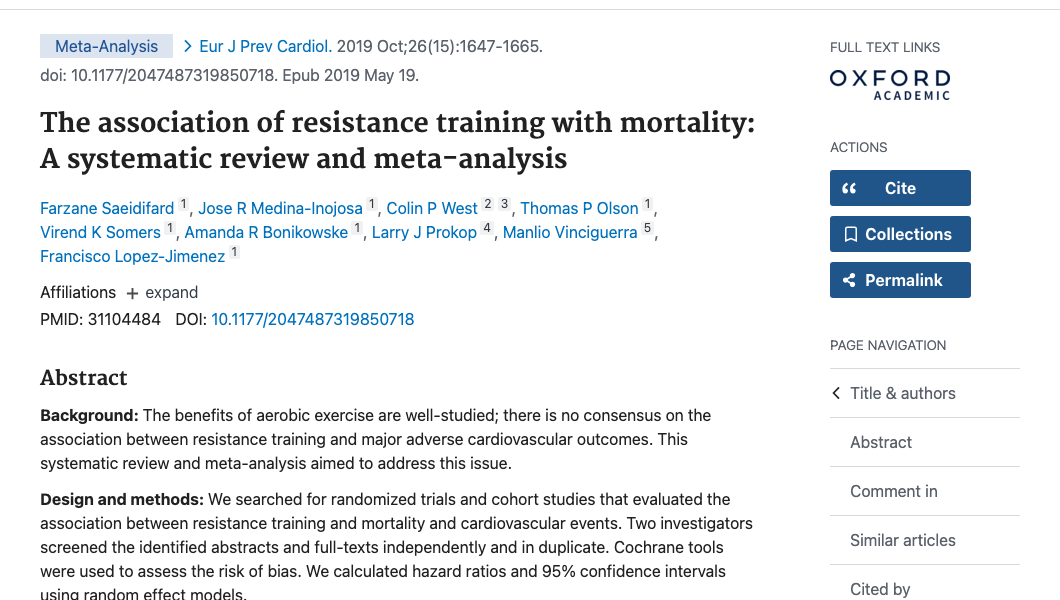
This systematic review and meta-analysis evaluated the association between resistance training and mortality outcomes. The analysis synthesized data from observational studies that examined whether engaging in resistance training was linked to reduced risk of death, and whether combining resistance training with aerobic exercise provided additional survival benefits.
The results demonstrated that resistance training was significantly associated with lower all-cause mortality. Notably, the combination of resistance training and aerobic exercise provided additive benefits beyond either modality alone, suggesting that a comprehensive exercise program incorporating both types of training is optimal for longevity. This finding has important implications for exercise prescription and public health guidelines.
However, the authors noted that the available data were insufficient to draw firm conclusions about the association between resistance training and specific non-fatal cardiovascular events. The study underscores the mortality-reducing potential of resistance training while highlighting the need for more research on disease-specific outcomes.
Methods
Systematic review and meta-analysis conducted according to PRISMA guidelines. The authors searched PubMed, Embase, Scopus, CINAHL, SPORTDiscus, and the Cochrane Library for observational studies examining the association between resistance training and mortality. Random-effects models were used to calculate pooled hazard ratios. Study quality was assessed using the Newcastle-Ottawa Scale.
Key Results
- Resistance training associated with significantly lower all-cause mortality risk
- Additive mortality benefit when RT combined with aerobic exercise (beyond either alone)
- Insufficient data to establish association with non-fatal cardiovascular events
- Subgroup analyses supported the robustness of the mortality association
Limitations
- All included studies were observational, limiting causal inference
- Self-reported exercise measures in most studies
- Insufficient data for analysis of non-fatal events (e.g., heart attack, stroke)
- Heterogeneity in how resistance training was defined and measured across studies
- Unable to determine optimal dose, frequency, or intensity of resistance training
- Potential residual confounding from other health behaviors