Key Takeaway
Any resistance training reduces all-cause mortality by 15%, cardiovascular mortality by 19%, and cancer mortality by 14%, with a nonlinear dose-response relationship.
Summary
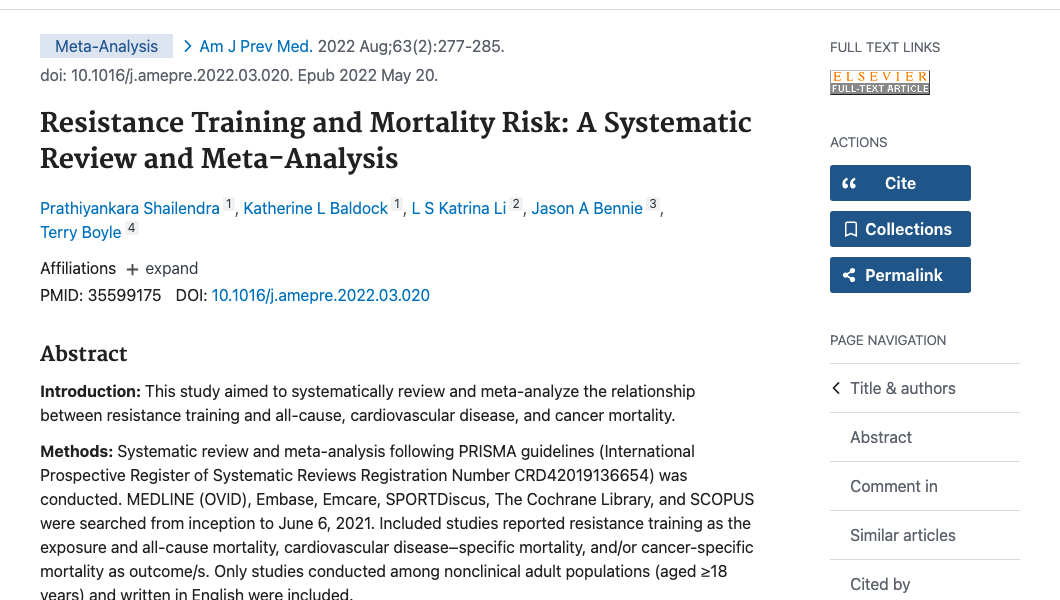
This systematic review and meta-analysis examined the association between resistance training and mortality risk across 10 prospective cohort studies. The analysis focused on whether engaging in any resistance training, compared to none, was associated with reduced risk of all-cause, cardiovascular, and cancer mortality in adult populations.
The pooled results demonstrated significant mortality reductions across all three outcomes. Participants who performed any resistance training had a 15% lower risk of all-cause mortality (RR=0.85), a 19% lower risk of cardiovascular mortality (RR=0.81), and a 14% lower risk of cancer mortality (RR=0.86) compared to those who did no resistance training. The dose-response analysis revealed a nonlinear relationship, suggesting that even modest amounts of resistance training confer meaningful survival benefits.
These findings reinforce resistance training as a critical component of public health recommendations, alongside aerobic exercise, for reducing premature mortality from the leading causes of death.
Methods
Systematic review and meta-analysis following PRISMA guidelines. The authors searched PubMed, CINAHL, Embase, and SPORTDiscus for prospective cohort studies examining the association between resistance training and mortality outcomes. Ten studies met inclusion criteria. Random-effects models were used for pooled analyses, and nonlinear dose-response relationships were examined using restricted cubic splines.
Key Results
- All-cause mortality: RR = 0.85 (15% risk reduction) for any RT vs. none
- Cardiovascular mortality: RR = 0.81 (19% risk reduction)
- Cancer mortality: RR = 0.86 (14% risk reduction)
- Nonlinear dose-response relationship observed — benefits plateau at higher volumes
- 10 prospective cohort studies included in the analysis
Limitations
- All included studies were observational (prospective cohorts), limiting causal inference
- Self-reported resistance training exposure in most studies
- Limited ability to assess dose-response precisely due to heterogeneous measurement of RT volume and intensity
- Potential residual confounding from healthier lifestyle behaviors among those who resistance train
- Most studies from Western populations, limiting generalizability