
Key Takeaway
Cold water immersion at 14°C increased plasma dopamine concentrations by 250%, demonstrating significant neuroendocrine effects of cold exposure.
Summary
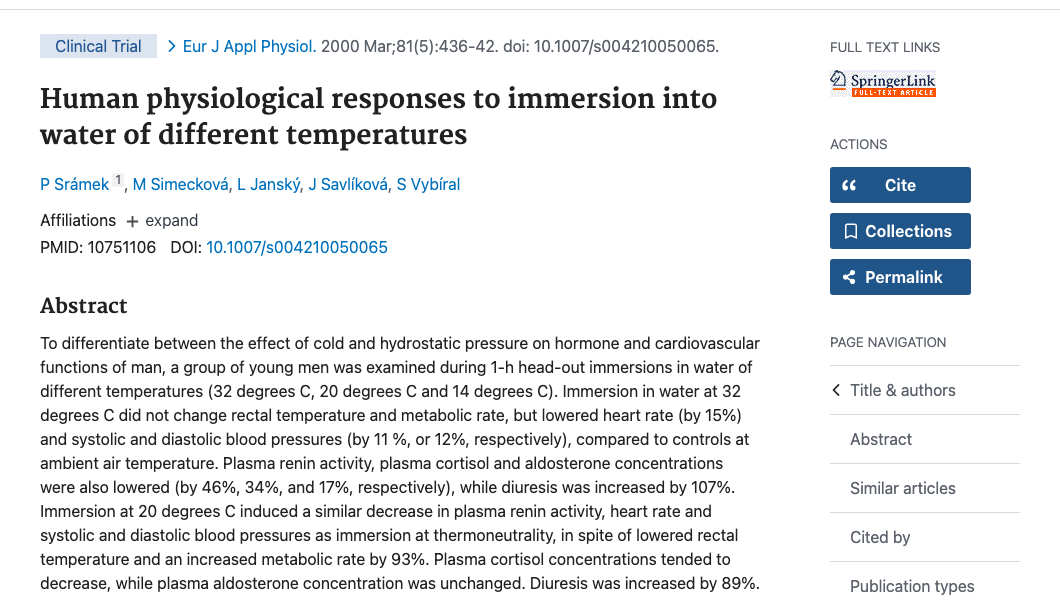
This study examined the effects of head-out water immersion at different temperatures (32°C, 20°C, and 14°C) on metabolic and hormonal responses in healthy young men.
The researchers found that cold water immersion at 14°C produced dramatic increases in plasma catecholamines, with dopamine increasing by 250% and norepinephrine by 530% compared to baseline. The 20°C condition showed more modest effects.
These findings demonstrate that cold exposure triggers significant neuroendocrine responses that may explain the mood-enhancing and energizing effects commonly reported by cold exposure practitioners.
Methods
- 10 young healthy men participated
- Head-out water immersion for 1 hour at three temperatures: 32°C (thermoneutral), 20°C (cool), and 14°C (cold)
- Blood samples collected before, during, and after immersion
- Measured metabolic rate, plasma catecholamines, cortisol, and other markers
Key Results
- 14°C immersion: Dopamine +250%, norepinephrine +530%
- 20°C immersion: Dopamine +93%, norepinephrine +350%
- Metabolic rate increased 350% in 14°C condition
- Effects persisted for some time after exiting water
Limitations
- Small sample size (n=10)
- Only young healthy men studied
- Laboratory conditions may not reflect real-world cold exposure practices
- Long duration (1 hour) differs from typical protocols