
Key Takeaway
Tai Chi produces large improvements in executive function (Hedges' g = 0.90) in cognitively healthy older adults and moderate improvements even compared to other exercise (g = 0.51).
Summary
This systematic review and meta-analysis, published in the Journal of the American Geriatrics Society, synthesized evidence from 20 studies with 2,553 participants aged 60 and older on the effects of Tai Chi on cognitive function. The review included 11 RCTs, one prospective non-randomized controlled study, four prospective observational studies, and four cross-sectional studies, encompassing both cognitively healthy individuals and those with cognitive impairment.
In cognitively healthy older adults, Tai Chi showed a large effect on executive function compared to non-intervention controls (Hedges' g = 0.90, p = .04) and a moderate effect compared to active exercise controls (Hedges' g = 0.51, p = .003). For older adults with cognitive impairment, Tai Chi produced smaller but still statistically significant improvements in global cognitive function versus both non-intervention controls (g = 0.35, p = .004) and other active interventions (g = 0.30, p = .002).
The authors conclude that Tai Chi shows strong potential for enhancing cognitive function in older adults, particularly executive functioning. The combination of physical movement, focused attention, and memorization of movement sequences may provide unique cognitive stimulation beyond standard exercise.
Methods
- Systematic search across multiple databases for studies on Tai Chi and cognition in adults 60+
- 20 eligible studies identified with 2,553 total participants
- 11 randomized controlled trials, 1 non-randomized controlled study, 4 observational, 4 cross-sectional
- Included participants both with and without cognitive impairment
- Cognitive outcomes assessed using a variety of neuropsychological tests
- Effect sizes calculated as Hedges' g with random effects meta-analysis
- Study quality assessed with risk of bias evaluation
Key Results
- Executive function in healthy adults vs. no intervention: Hedges' g = 0.90 (p = .04) - large effect
- Executive function in healthy adults vs. exercise controls: Hedges' g = 0.51 (p = .003) - moderate effect
- Global cognition in impaired adults vs. no intervention: Hedges' g = 0.35 (p = .004)
- Global cognition in impaired adults vs. active interventions: Hedges' g = 0.30 (p = .002)
- Tai Chi benefits exceeded those of generic exercise for executive function
- Both cognitively healthy and impaired populations benefited
Figures
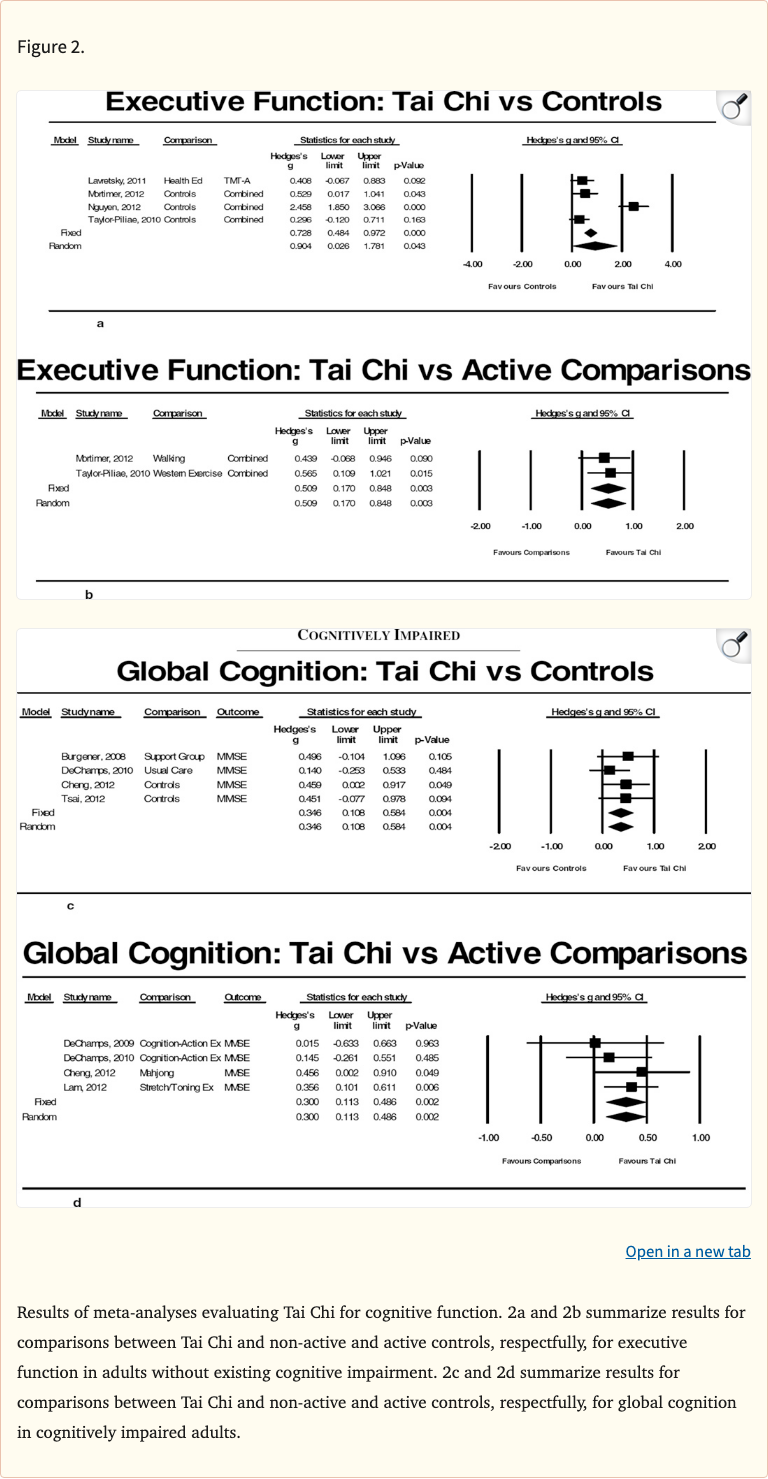 Figure 1
Limitations
- Overall RCT quality was modest; 3 of 11 trials had high risk of bias
- Heterogeneity in cognitive outcome measures across studies
- Variety of Tai Chi styles and program durations made direct comparisons difficult
- Limited long-term follow-up data
- Authors recommend larger, methodologically sound trials with longer follow-up periods