
Key Takeaway
Dehydration significantly impairs cognitive performance (ES = -0.21), especially attention, executive function, and motor coordination when water deficit exceeds 2% body mass.
Summary
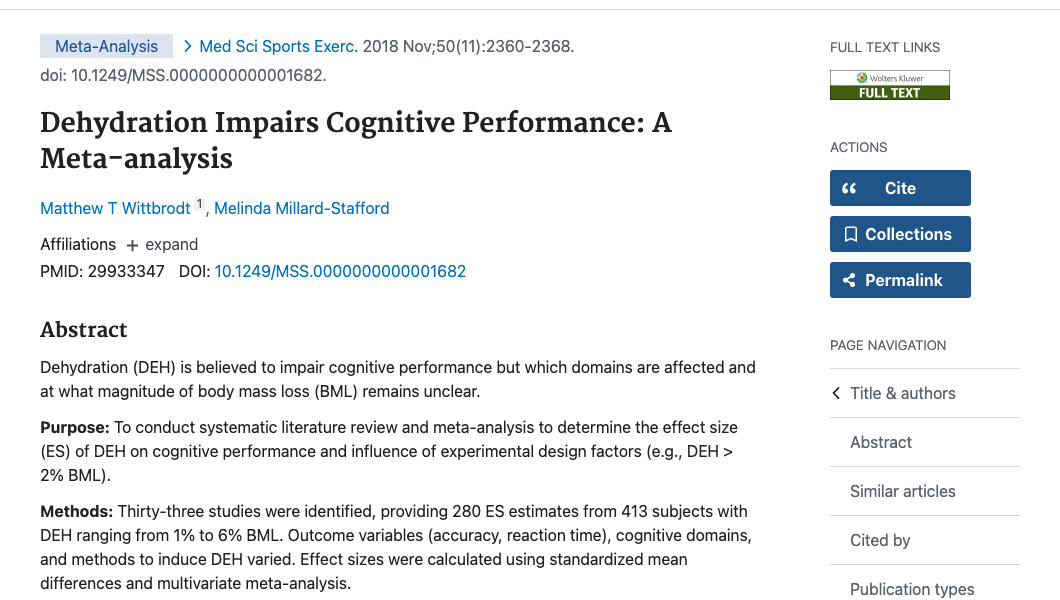
This meta-analysis quantified the effects of dehydration on cognitive performance across multiple domains. The authors pooled data from studies that manipulated hydration status through exercise, heat exposure, or fluid restriction and then measured cognitive outcomes.
The analysis found a statistically significant overall negative effect of dehydration on cognition (effect size = -0.21), indicating that even modest fluid deficits impair mental performance. The impairment was most pronounced for tasks requiring attention, executive function, and motor coordination.
Dehydration exceeding 2% body mass loss produced the most consistent cognitive decrements. These findings underscore the importance of maintaining adequate hydration, particularly during exercise, heat exposure, or prolonged mental work where fluid losses are elevated. Electrolyte-containing beverages may help sustain hydration more effectively than water alone in high-sweat-loss scenarios.
Methods
Systematic review and meta-analysis of studies examining dehydration effects on cognitive performance. Included studies used controlled dehydration protocols (exercise-induced, passive heat, fluid restriction) and assessed cognitive function with validated tests. Effect sizes were calculated across cognitive domains using random-effects models. Moderator analyses examined the influence of dehydration severity (% body mass loss) and cognitive domain.
Key Results
- Overall effect of dehydration on cognition was significant (ES = -0.21)
- Attention and executive function were the most impaired cognitive domains
- Motor coordination showed consistent degradation with dehydration
- Cognitive impairment became more reliable when body mass loss exceeded 2%
- Both exercise-induced and passive dehydration produced cognitive decrements
Limitations
- Heterogeneity in dehydration protocols and cognitive tests across studies
- Difficult to fully separate dehydration effects from exercise fatigue or heat stress
- Most studies used young, healthy, physically active participants, limiting generalizability
- Few studies examined dehydration below 1% body mass loss
- Rehydration timing and composition (water vs. electrolytes) were not the focus of most included studies
