
Key Takeaway
Yoga produced a small effect on balance (g=0.40) and medium effect on physical mobility (g=0.50) in adults aged 60+, based on 6 high-quality RCTs with 307 participants.
Summary
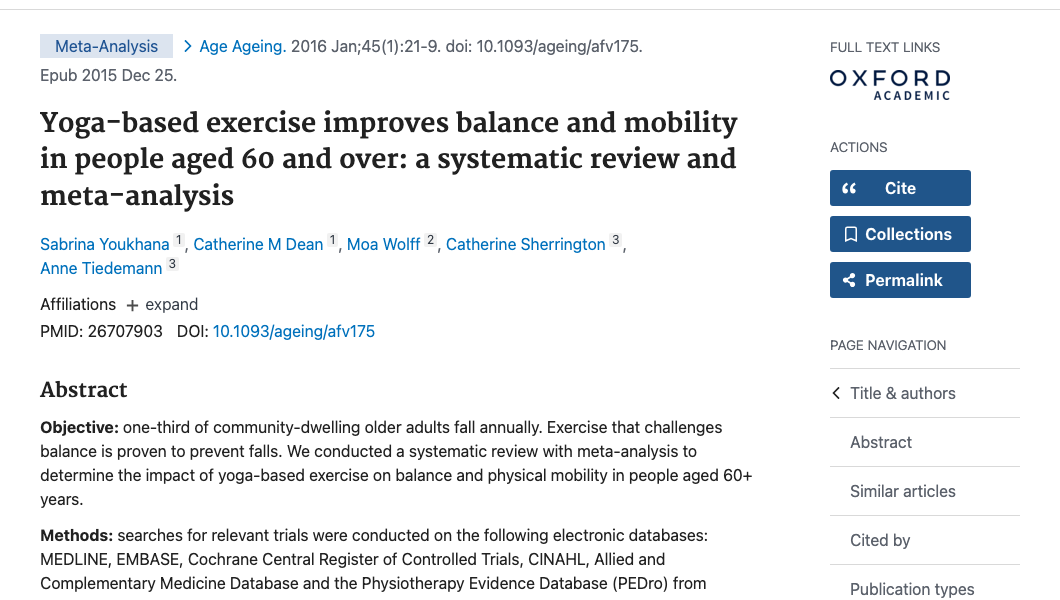
This systematic review and meta-analysis searched six databases for RCTs evaluating physical yoga (excluding meditation-only or breathing-only interventions) in people aged 60 and over. Six trials of high methodological quality with 307 total participants met inclusion criteria.
Yoga produced a small but significant improvement in balance (Hedges' g = 0.40, 95% CI 0.15-0.65) and a medium improvement in physical mobility (Hedges' g = 0.50, 95% CI 0.06-0.95). Published in Age and Ageing, a top geriatrics journal, these findings support yoga as a practical intervention for age-related balance and mobility decline.
The authors note that while the balance and mobility improvements are clear, whether they translate to actual fall reduction remains to be established in future research.
Methods
- Systematic search of 6 databases through February 2015
- Included RCTs of physical yoga in adults aged 60+
- Excluded meditation-only and breathing-only interventions
- 6 high-quality trials, 307 participants
- Effect sizes calculated using Hedges' g
Key Results
- Balance: Hedges' g = 0.40 (95% CI 0.15-0.65) — small effect
- Physical mobility: Hedges' g = 0.50 (95% CI 0.06-0.95) — medium effect
- Both statistically significant
Limitations
- Only 6 trials met quality criteria despite large yoga literature
- Small total sample (307 participants)
- Fall reduction not directly measured
- Various yoga styles across studies