Summary
Laurel Beversdorf tackles two common strength training myths: the idea that improving grip strength directly extends your lifespan (it's a marker, not a cause), and the belief that single-leg exercises are mainly for balance. She explains the three types of grip, why correlation doesn't equal causation in longevity research, and when unilateral training actually shines.
Key Points
- Grip strength correlates with longevity but doesn't cause it -- the physical activity behind a strong grip is what extends lifespan.
- There are three distinct grip types (support, pinch, crushing) and training one doesn't fully transfer to the others due to specificity.
- Grip strength tested in research uses crushing grip via dynamometer, which differs from the support grip used in most barbell training.
- Genetics play a large role in grip strength; two people doing the same program will see different results.
- Single-leg exercises are better justified for addressing asymmetries and increasing range of motion than for improving balance.
- Balance in strength training improves most through progressive overload of compound lifts, not by adding instability to exercises.
Key Moments
Another benefit of single leg exercises is to help break through plateaus
Another benefit of single leg exercises is to help break through plateaus. You might be experiencing in bilateral exercises to introduce new movement patterns that provide a fresh stimulus to your body.
"working unilaterally can make a change to your lower body strength. Another benefit of single leg exercises is to help break through plateaus. You might be experiencing in bilateral exercises to introduce new movement patterns that provide a fresh stimulus to your body. Stepping away, say, from the back squat to focus on lunging."
Correlation does not equal causation
Alright, starting with grip strength and a common way the relationship between grip strength and longevity is misinterpreted. Just because two things are linked doesn't mean one caused the other.
"Alright, starting with grip strength and a common way the relationship between grip strength and longevity is misinterpreted. So let's start with a good reminder for all of us working in the health and fitness industry. Correlation does not equal causation. Just because two things are linked doesn't mean one caused the other. A classic example is the correlation between ice cream sales and drowning incidents. Both go up in the summer."
The most common way grip strength is tested in research
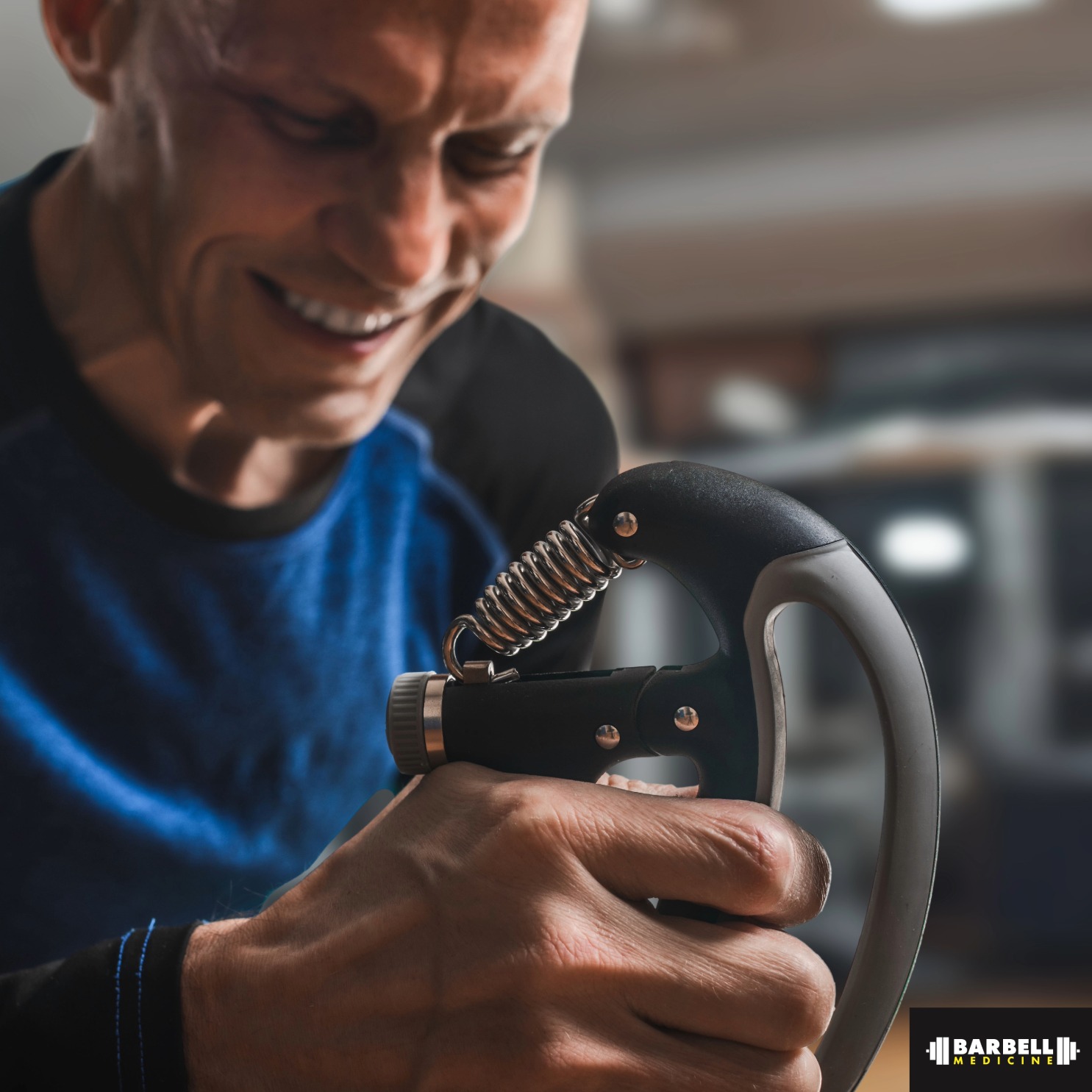
The most common way grip strength is tested in research. When grip is measured in research, they use a machine called a dynamometer to test the force someone can generate with a crushing grip.
"The most common way grip strength is tested in research. When grip is measured in research, they use a machine called a dynamometer to test the force someone can generate with a crushing grip. In a real life context, this is the type of grip you demonstrate when you shake someone's hand and you want to make sure they don't leave that interaction thinking you have a weak handshake."
Resistance Training: And just something else that I think is
And just something else that I think is interesting about these differences is that crushing grip, which is tested in research, ends up serving as this marker of overall health and vitality, whereas the support grip is the thing we're progressively overloading in strength training that is the way ou
"And just something else that I think is interesting about these differences is that crushing grip, which is tested in research, ends up serving as this marker of overall health and vitality, whereas the support grip is the thing we're progressively overloading in strength training that is the way our grip... as well as our whole body is becoming stronger. Another important consideration in grip strength is the role that genetics play."