Summary
Andrew Huberman interviews physical therapist and strength coach Jeff Cavaliere about designing effective exercise programs. Cavaliere recommends a 60-40 split between weight training and conditioning, with workouts kept under an hour. They discuss training splits (bro splits, push-pull-legs, total body), when to combine cardio with resistance training, and the importance of the mind-muscle connection for hypertrophy. The conversation covers shoulder health and why the upright row is biomechanically risky, with Cavaliere recommending the high pull as a safer alternative that preserves external rotation. They discuss grip mechanics and how letting the bar drift into the fingertips during pulling exercises causes medial epicondylitis (elbow pain), with proper bar placement in the palm solving the issue. Cavaliere also explains using grip strength as a recovery metric, noting that a 10% or greater drop in grip output signals the body is not recovered enough to train effectively.
Key Points
- A 60-40 split favoring weight training over conditioning is a good starting framework, with 3 strength days and 2 conditioning days per week
- The best training split is the one you will actually stick to — consistency matters more than the theoretical optimality of any split
- Conditioning should go at the end of a weight training session to avoid compromising strength work intensity
- The upright row puts the shoulder in a biomechanically compromised internal rotation position; the high pull is a safer alternative
- Bar placement matters for elbow health: letting the bar drift into the fingertips during pulling exercises stresses the medial epicondyle and causes elbow pain
- Grip strength can serve as a recovery metric — a 10% or greater decline from baseline suggests skipping the gym that day
- Dynamic stretching before workouts improves readiness without disrupting length-tension relationships, while passive stretching is best done away from training
- The mind-muscle connection improves with practice and varies exercise to exercise, not just muscle to muscle
Key Moments
Grip strength as a recovery and performance metric
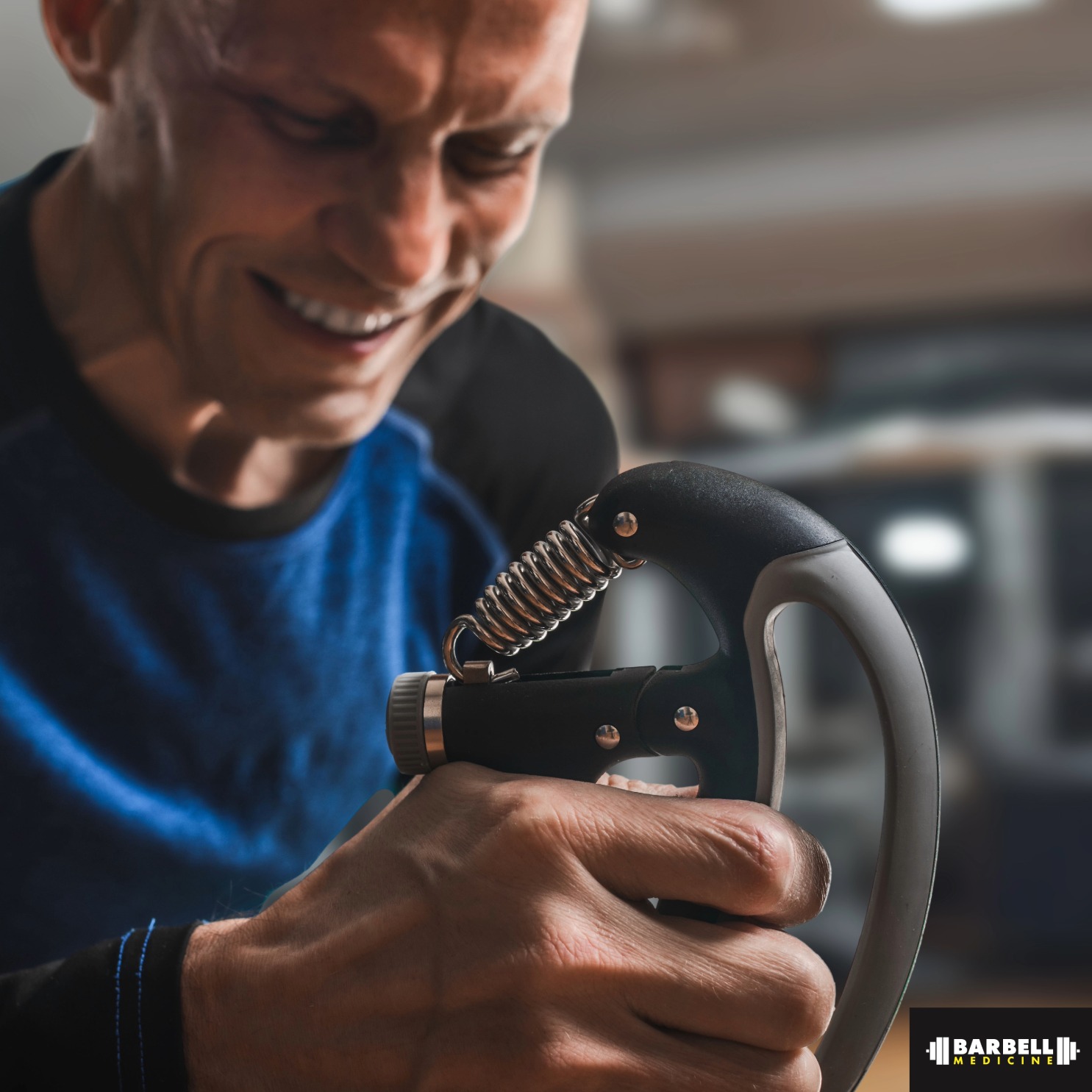
Jeff Cavaliere explains how grip strength measurements served as a baseline recovery metric for MLB players, noting that a 10% or greater drop in grip output signals the body is too fatigued to train effectively.
"grip strength is very, very much tied to performance and recovery. And when I was at the Mets, we used to actually take grip strength measurements as a baseline in spring training all the time."
Why bar placement in the palm prevents elbow pain
Cavaliere explains that letting a bar drift into the fingertips during pulling exercises stresses the medial epicondyle, causing chronic elbow pain. Keeping knuckles over the bar and the weight in the meat of the palm fixes this.
"That bar can drift just by gravity doing its thing or fatigue of the hand grip can start to drift further away towards the distal digits, right?"
The upright row is a diagnostic test for shoulder impingement disguised as an exercise
Cavaliere explains that the upright row puts the shoulder into the exact position used to diagnose impingement (the Hawkins-Kennedy test), and recommends the high pull as a safer alternative that keeps the hand above the elbow.
"Pretty much the exact position that we're in when we're holding a bar in an upright row. Some will say, well, just don't go so high, go only up to the level of the chest, but you're still in this internally rotated position."