Summary
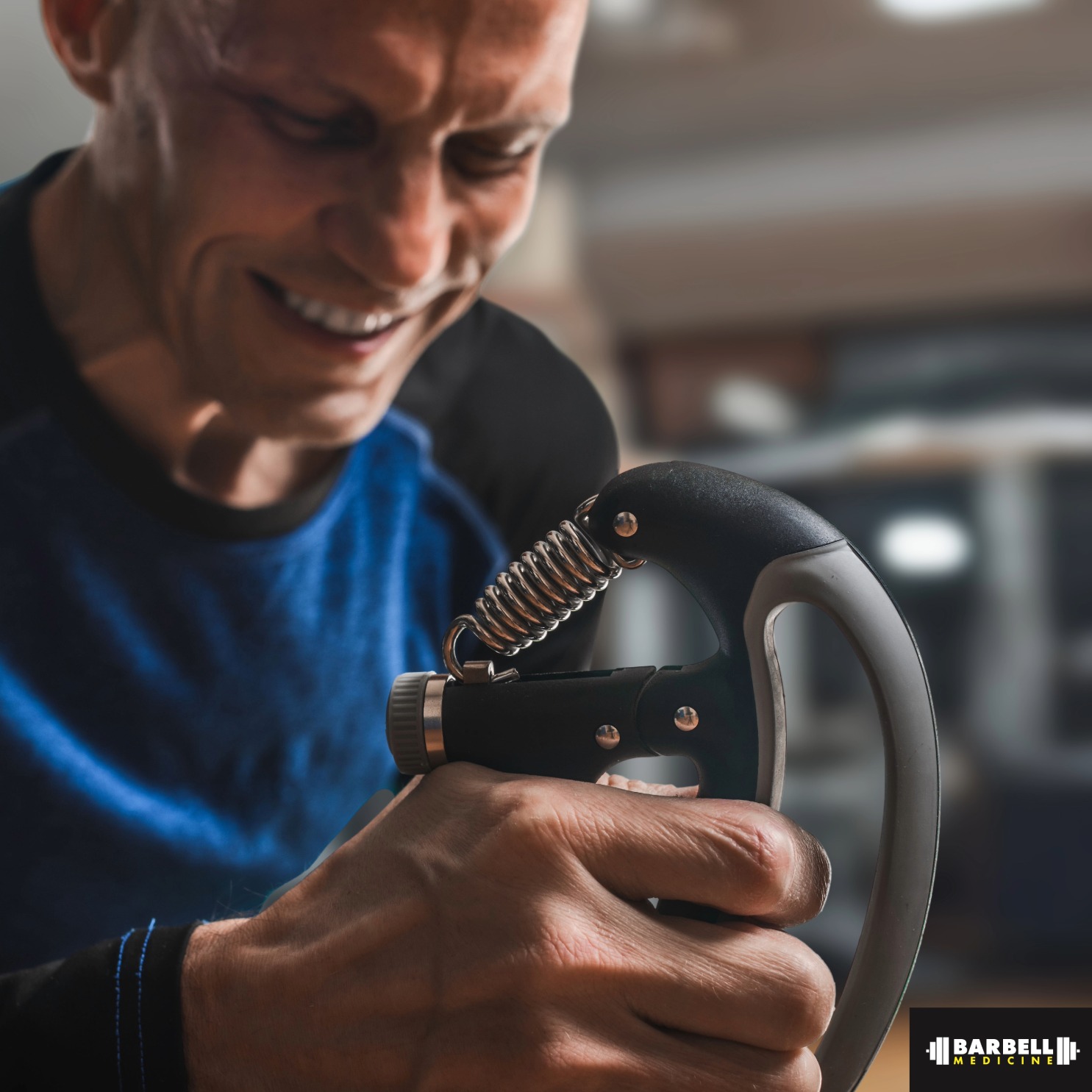
Dr. Jordan Feigenbaum and Dr. Austin Baraki of Barbell Medicine take a nuanced, contrarian look at grip strength as a health metric. They argue that grip strength is a thermometer, not a heater — it measures systemic health but training it directly does not improve longevity. The episode walks through the full neuromuscular pathway from motor cortex to muscle contraction, explaining why grip strength correlates with all-cause mortality, cardiovascular disease, and cognitive decline. The hosts push back on several popular claims in a "bro science beat down" segment: neural jitter in grip testing may detect neurodegenerative disease years before symptoms appear, but using daily grip strength as a training readiness metric is unsupported by human data. They argue that isolated extensor training is unnecessary for healthy populations since extensors are already active during gripping, and that direct grip training for longevity is misguided — whole-body resistance training is what actually moves the needle. They also defend the use of lifting straps, noting they allow greater training loads and do not eliminate grip involvement.
Key Points
- Grip strength is a thermometer for systemic health, not a heater — training grip directly does not improve mortality outcomes
- Below 26 kg for men or 16 kg for women on a hand dynamometer is a medical red flag consistent with sarcopenia
- The grip test captures the integrity of the entire neuromuscular chain from motor cortex through spinal cord to muscle contraction
- Neural jitter (oscillating signal during max grip) may detect Parkinson's and Alzheimer's years before physical symptoms emerge
- Using daily grip strength as a training readiness metric has no supporting human data and is not better than subjective self-assessment
- Isolated finger extensor training is largely unsupported for healthy populations — extensors are already active during gripping to stabilize the wrist
- Lifting straps do not eliminate grip involvement and can allow greater training loads, potentially increasing fitness adaptations
- Whole-body resistance training is the appropriate intervention for low grip strength, not isolated grip work
Key Moments
Grip strength is a thermometer, not a heater
Dr. Feigenbaum explains that grip strength is one of the most predictive single metrics for cardiovascular disease, cognitive decline, and all-cause mortality, but training it directly is like holding a match under a thermometer to warm the room.
"If you train your grip to quote live longer, you're essentially holding a match under that thermometer to make the room feel warmer. You might see a higher number on the dial, but the house is still freezing."
Neural jitter as an early neurodegenerative disease signal
When squeezing a dynamometer, an oscillating or non-smooth signal (neural jitter) can indicate neurodegenerative disease like Parkinson's or Alzheimer's years before other physical symptoms appear.
"if that signal isn't smooth, but instead it's oscillating or waxing and waning, that can be the brain trying to tell us something. Sometimes you can see this with pathology, there's a bunch of research on this in different neurodegenerative diseases like Parkinson's and Alzheimer's, where they have this sort of non-smooth signal when they're trying to do a hand grip strength that occurs years before other physical symptoms"
Why isolated extensor training is unnecessary for healthy people
The claim that you must train finger extensors to balance out flexion is largely unsupported. The extensors are already heavily active during gripping to stabilize the wrist and prevent active insufficiency.
"the extensors are heavily active when you grip anything anyway, that's how your wrist stays stable and prevents active insufficiency. What do you think those muscles on the backside of your arm are doing? It's not like they're just hanging out waiting to do something. They're active."
Whole-body training beats direct grip training for health outcomes
Indirect resistance training improves grip strength in sarcopenic individuals and prevents further loss of type 2 motor neurons. Direct grip training follows the SAID principle but does not confer additional health benefits beyond what whole-body training provides.
"if a person has a sort of low grip strength and they do indirect resistance training, this is particularly true in individual of the sarcopenia that their hand grip strength improves. which is exactly what you would expect. It prevents further loss of type 2 motor neurons, so kind of stops sarcopenia cold in its tracks."