
Key Takeaway
Resistance training with external loads produces moderate ROM improvements comparable to stretching (ES = 0.73), with untrained individuals benefiting most.
Summary
This large-scale meta-analysis examined whether resistance training alone can improve joint flexibility. The authors analyzed 55 studies with 2,756 participants (mean age 23.9 years) across four databases (PubMed, SPORTDiscus, Web of Science, Scopus).
The central finding was that resistance training with external loads produced a moderate, statistically significant improvement in range of motion compared to controls (ES = 0.73; p < 0.001). Critically, there was no meaningful difference between resistance training and stretching for ROM gains (ES = 0.08; p = 0.79), and adding stretching to resistance training provided no additional benefit over stretching alone.
An important nuance emerged in subgroup analysis: body-weight-only exercises did not significantly improve ROM, suggesting that external loading is important for the flexibility-building effect. Untrained individuals showed substantially greater improvements (ES = 1.04) compared to trained participants (ES = 0.43). These findings support the practical recommendation that resistance training through full ranges of motion can replace dedicated stretching for most people seeking flexibility gains.
Methods
- Searched PubMed, SPORTDiscus, Web of Science, Scopus, and Google Scholar
- Included 55 controlled or randomized controlled trials with 2,756 participants
- Compared RT vs control, RT vs stretching, and RT + stretching vs stretching alone
- Random-effects meta-analysis with subgroup analyses by sex and activity level
- Meta-regression assessed age, training frequency, and duration as moderators
- Mean participant age 23.9 +/- 6.3 years (range 8.1-78.8)
Key Results
- RT with external loads improved ROM vs controls (ES = 0.73; p < 0.001)
- No significant difference between RT and stretching (ES = 0.08; p = 0.79)
- Combined RT + stretching no better than stretching alone (ES = -0.001; p = 0.996)
- Body-weight exercises did not significantly improve ROM
- Untrained individuals showed greater gains (ES = 1.04) than trained (ES = 0.43)
- No significant effects of sex, age, training duration, or frequency
Figures
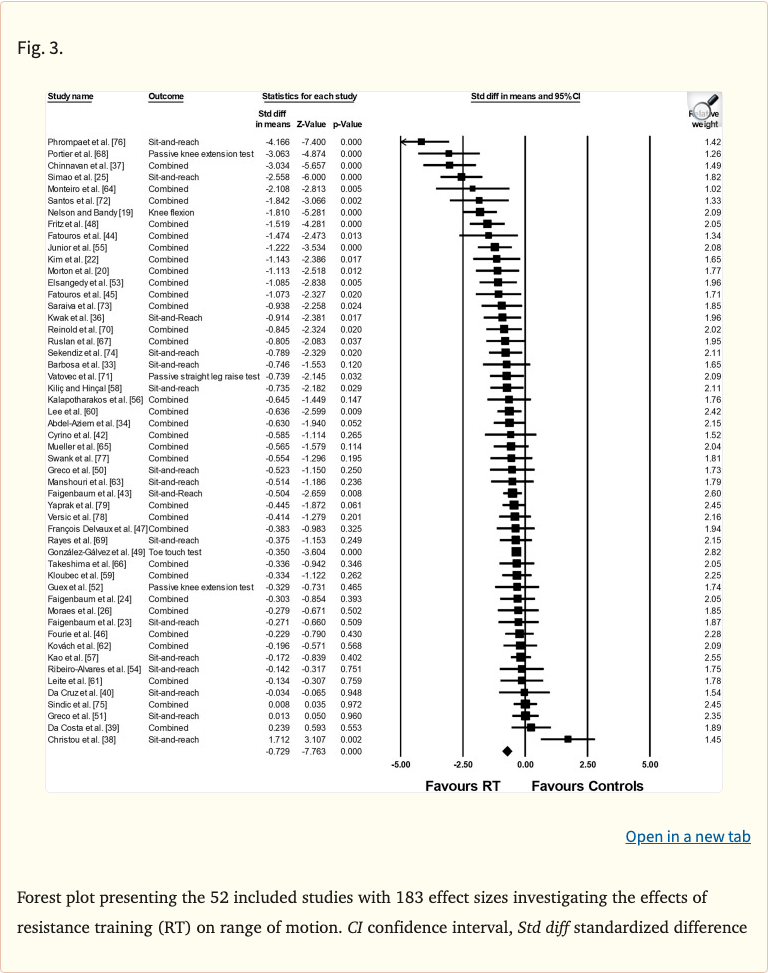 Figure 2
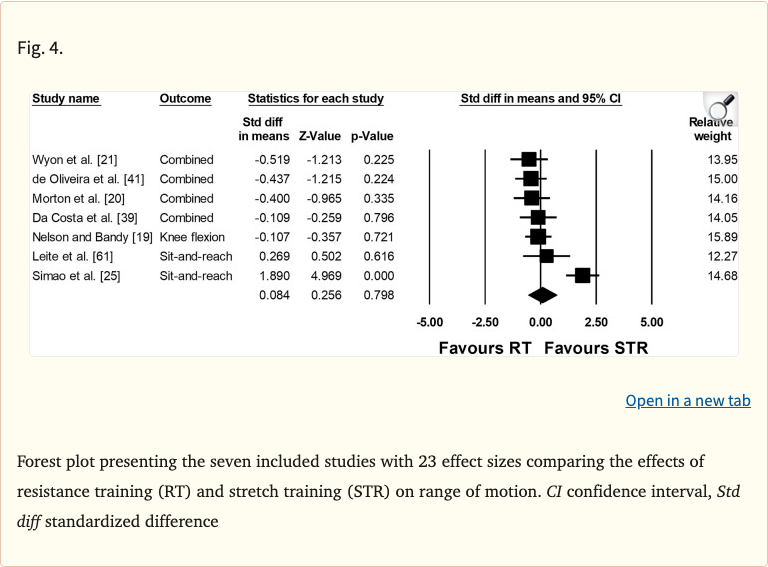 Figure 3
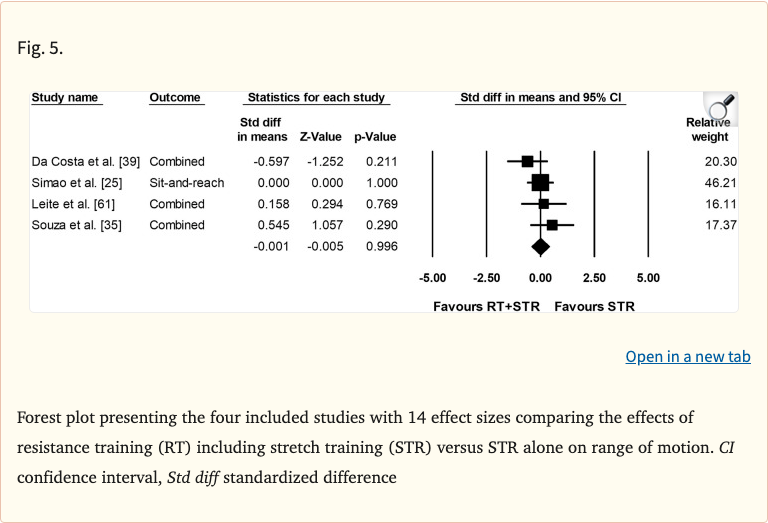 Figure 4
Limitations
- Combining different ROM tests may reduce measurement sensitivity
- Statistical method does not fully account for dependency when multiple effect sizes come from one study
- Reporting bias detected for RT vs control comparisons
- Predominantly young participants (mean age ~24) limits generalizability to older adults
- Heterogeneous training protocols across included studies