
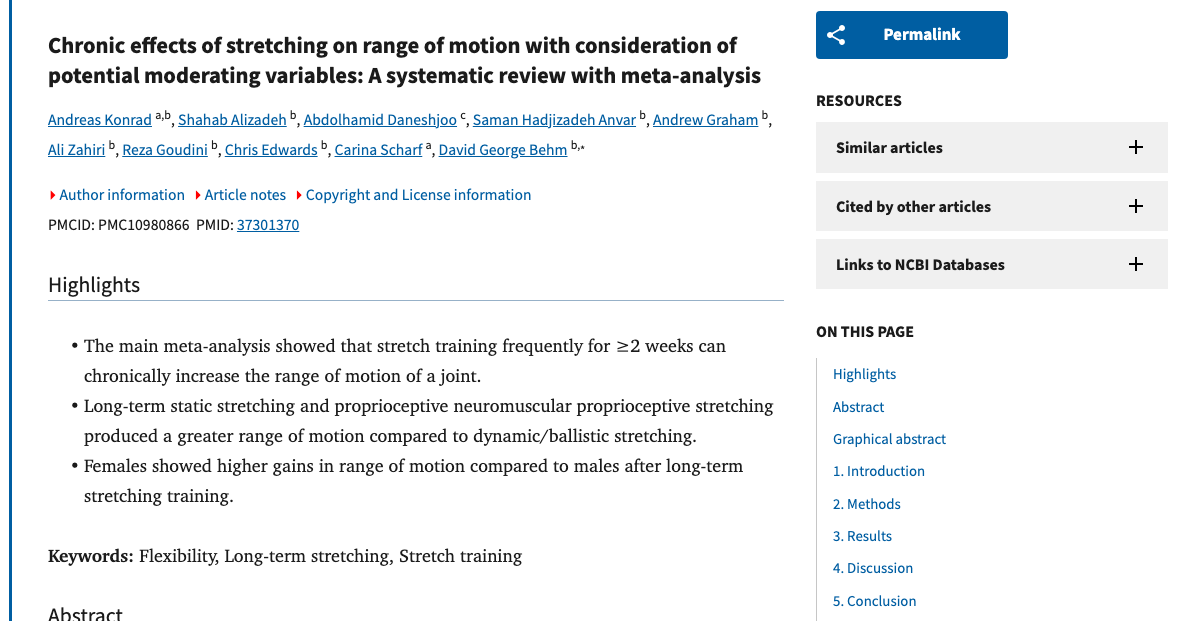
Key Takeaway
Chronic stretching produces moderate ROM improvements (ES = 1.0), with PNF and static stretching significantly outperforming ballistic/dynamic stretching, while training dose variables show minimal impact.
Summary
This comprehensive meta-analysis examined the chronic effects of stretch training on range of motion and investigated which moderating variables influence outcomes. The authors analyzed 77 studies with 186 effect sizes from 3,870 participants, making it one of the largest meta-analyses on stretching and flexibility.
The overall finding was that stretch training significantly increases ROM with a moderate effect size (ES = 1.0; p < 0.001) compared to controls. The most important moderator was stretching technique: PNF stretching (ES = 1.28) and static stretching (ES = 1.0) both produced significantly greater ROM gains than ballistic or dynamic stretching (ES = 0.55). There was no significant difference between PNF and static stretching.
A surprising finding was that dose-response variables -- including total stretch duration, weekly frequency, and training volume -- showed no significant relationship with ROM outcomes. This suggests that consistency matters more than volume when it comes to flexibility training. Females showed somewhat greater gains than males, though this finding had limited statistical significance in moderation testing. The results provide practical guidance: for long-term flexibility gains, static stretching or PNF are clearly superior to ballistic approaches.
Methods
- Searched PubMed, Scopus, Web of Science, and SportDiscus through September 2022
- Included 77 RCTs with interventions lasting 2+ weeks (3,870 participants)
- 186 effect sizes analyzed using random-effects models
- Subgroup analyses by stretching technique (PNF, static, ballistic/dynamic)
- Moderator analyses for sex, age, stretch duration, and frequency
- Meta-regression for dose-response relationships
- Publication bias assessed via funnel plots and Egger's test
Key Results
- Stretch training increased ROM with moderate effect (ES = 1.0; p < 0.001)
- PNF (ES = 1.28) and static stretching (ES = 1.0) outperformed ballistic/dynamic (ES = 0.55; p = 0.01)
- No significant difference between PNF and static stretching
- Females showed greater gains (ES = 1.56) than males (ES = 0.89; p = 0.04)
- No significant dose-response relationship for volume, frequency, or duration
- Substantial heterogeneity across studies (I² = 74.97%)
Figures
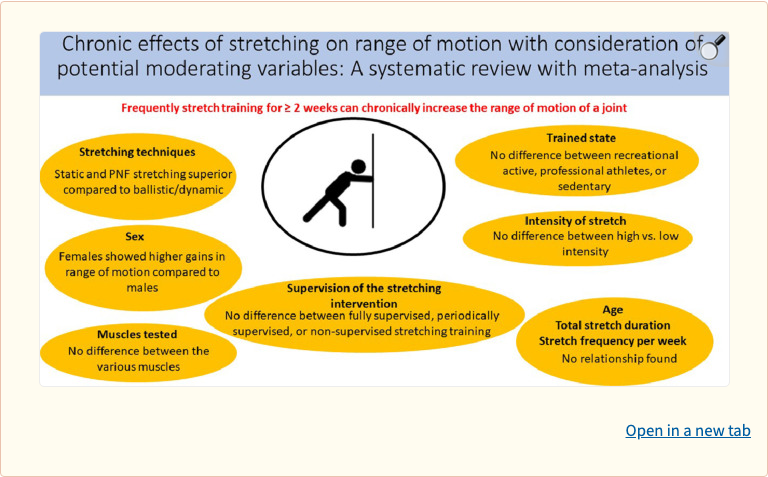 Figure 1
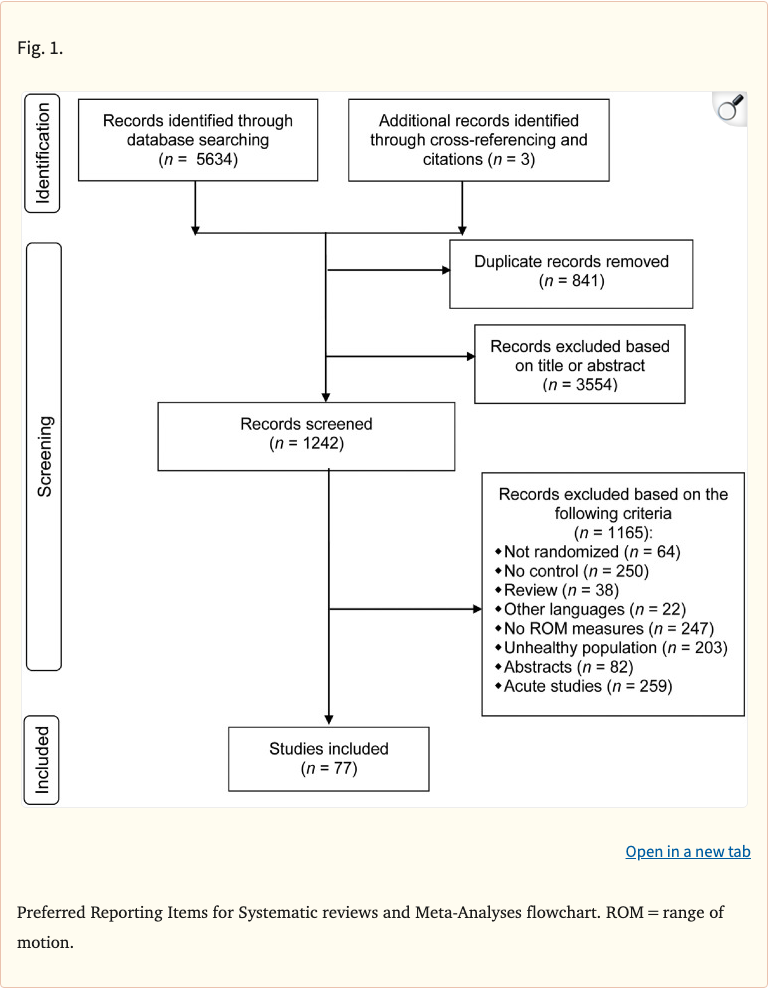 Figure 2
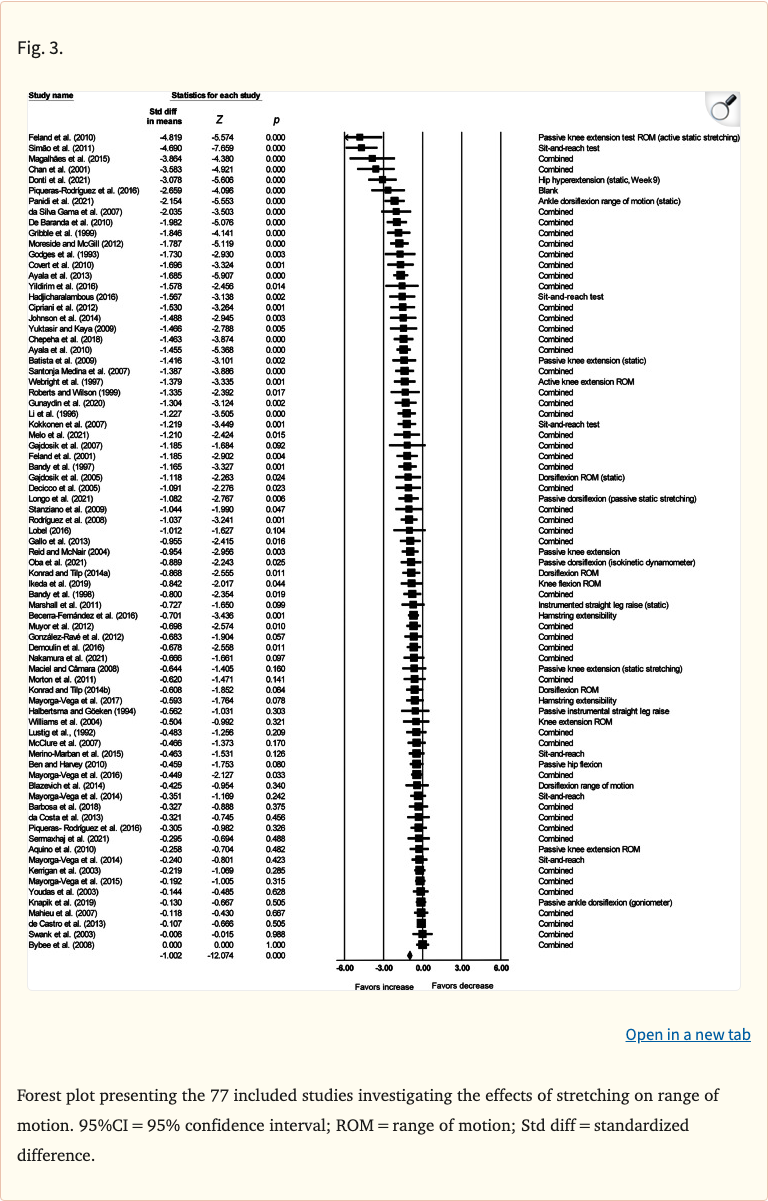 Figure 4
Limitations
- Publication bias detected (Egger's test p < 0.001) toward positive results
- Substantial heterogeneity (I² = 74.97%) from varying outcome measures and protocols
- Findings may not generalize to populations requiring extreme flexibility (gymnasts, dancers)
- Predominantly young participants limits conclusions for elderly populations
- Most studies assessed passive ROM rather than active functional range