Key Takeaway
Foam rolling training programs longer than 4 weeks are needed to produce meaningful ROM gains, and responses are muscle- and joint-specific rather than universal.
Summary
This systematic review and meta-analysis, published in Sports Medicine, investigated the training effects of repeated foam rolling interventions on range of motion. Unlike studies examining acute single-session effects, this review focused on longer-term foam rolling programs to determine whether consistent use leads to lasting flexibility improvements.
The analysis found that foam rolling training can improve ROM, but the effects are duration-dependent. Interventions lasting more than 4 weeks showed more consistent and meaningful improvements compared to shorter programs. This suggests that foam rolling needs to be practiced regularly over an extended period to produce lasting changes in tissue extensibility, rather than relying on temporary acute effects alone.
A key finding was that ROM responses to foam rolling are muscle-group and joint-specific. Not all body regions respond equally, which has practical implications for programming. Practitioners should target specific areas where flexibility limitations exist rather than applying a generic whole-body foam rolling protocol. The results were published in Sports Medicine (2022;52(10):2523-2535), lending credibility given the journal's high impact factor in sports science.
Methods
Systematic review and meta-analysis of studies examining foam rolling training interventions (multiple sessions over time) on ROM outcomes. Searched major databases for controlled trials comparing foam rolling programs to control conditions. Analyzed effects by intervention duration, muscle group, and joint. Subgroup analyses performed for program length (shorter vs. longer than 4 weeks) and body region.
Key Results
- Foam rolling training improves ROM, but effects are duration-dependent
- Programs >4 weeks showed more consistent ROM improvements than shorter programs
- ROM responses are muscle- and joint-specific (not uniform across body regions)
- Some muscle groups respond more favorably than others to foam rolling training
- Published in Sports Medicine 2022;52(10):2523-2535
Figures
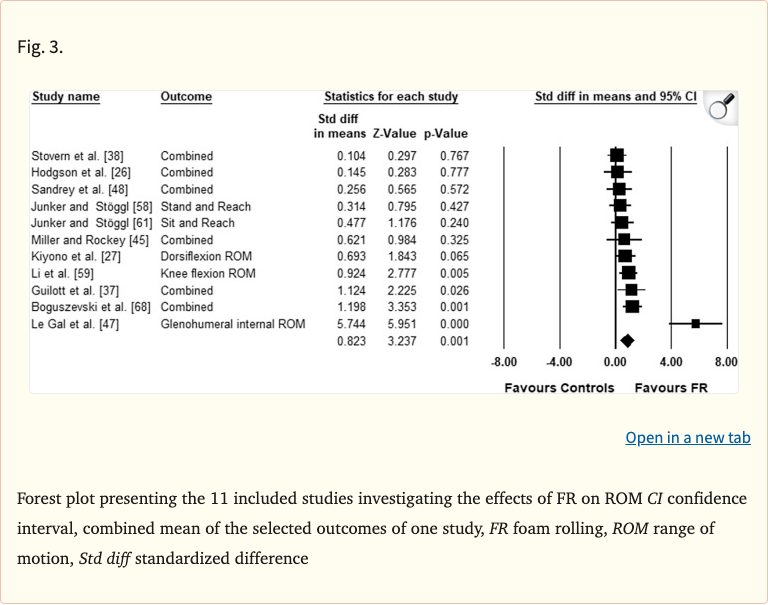 Figure 2
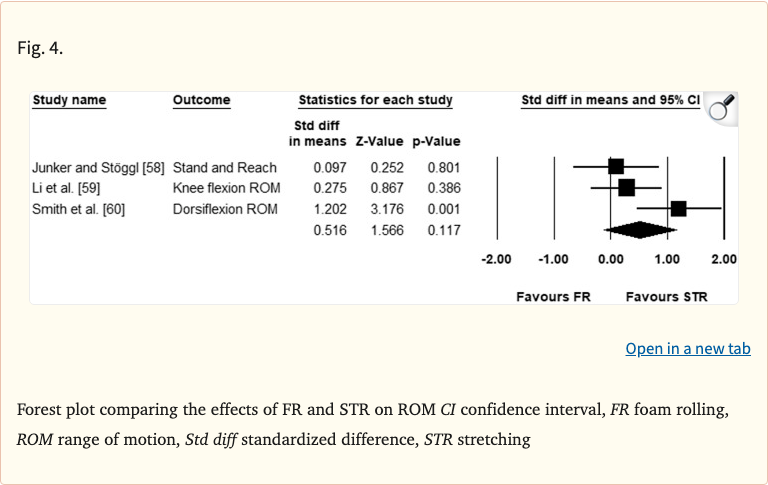 Figure 3
Limitations
- Heterogeneity in foam rolling protocols (tool type, pressure, duration per session)
- Limited number of long-term studies (>8 weeks)
- Most studies used healthy, young populations limiting generalizability
- Difficulty standardizing foam rolling pressure across studies
- Potential confounding from concurrent stretching or training programs