
Key Takeaway
Largest breathwork study to date found SOMA breathwork produces psychedelic-like neural changes, with increased brain complexity during breath holds similar to psilocybin effects.
Summary
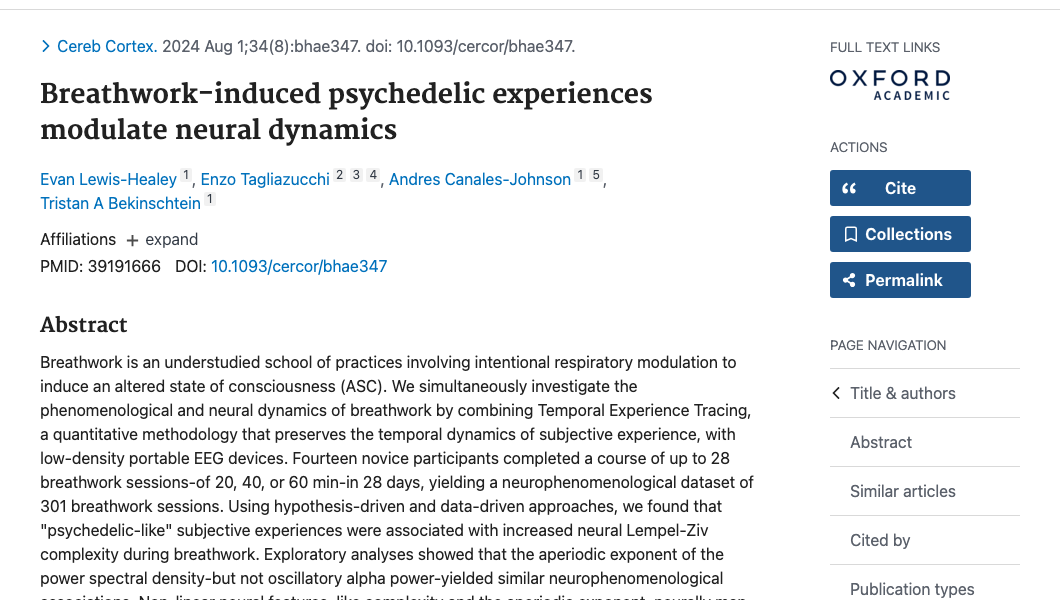
This pioneering study from the University of Cambridge represents the largest scientific investigation into breathwork's effects on the brain. Researchers analyzed over 300 breathwork sessions from 14 participants who practiced SOMA Breath daily for 28 days, using portable EEG technology.
The study found that breathwork-induced positive experiences were associated with increased neural Lempel-Ziv complexity - indicating richer, more diverse brain activity similar to psychedelic states. Participants reported heightened bliss, insightfulness, and spiritual experiences, particularly during breath-hold phases.
When compared to prior psilocybin and MDMA studies, SOMA breathwork scored higher in unity, spiritual connection, and meaning, but lower in vivid imagery. This suggests breathwork may offer an accessible, non-pharmacological route to altered states of consciousness.
Methods
- 14 participants, daily practice for 28 days
- 300+ breathwork sessions analyzed
- Portable EEG brain monitoring
- Novel Temporal Experience Tracing (TET) technique
- Comparison to prior psychedelic research data
Key Results
- Increased neural Lempel-Ziv complexity during breathwork
- Global decrease in alpha1 brainwaves (up to 25%)
- Theta increase in posterior cingulate cortex
- Gamma increase in insula (emotional engagement)
- Two distinct experiential states identified
- Decreased anxiety and negative states over time
Limitations
- Now published in Cerebral Cortex (previously preprint)
- Small sample size (n=14)
- Single breathwork method (SOMA Breath)
- No placebo/control breathwork condition
- Self-selected participants interested in breathwork