Key Takeaway
Analysis of over 960,000 chiropractic sessions found very low rates of serious adverse events, supporting the safety profile of spinal manipulation when performed by qualified practitioners
Summary
This large-scale observational study published in Scientific Reports analyzed the safety of chiropractic spinal manipulative therapy across a dataset of over 960,000 treatment sessions. The study examined adverse event rates and characterized the types and severity of adverse events that occurred.
The results demonstrated a very low rate of serious adverse events. The most common side effects were mild and transient, including local soreness, stiffness, and temporary discomfort. Serious adverse events such as vertebral artery dissection or cauda equina syndrome were extremely rare.
This study provides important real-world safety data that complements the controlled trial evidence. The large sample size gives statistical power to detect even rare adverse events, making it one of the most comprehensive safety assessments of chiropractic SMT to date. The findings support that SMT performed by qualified chiropractors has a favorable safety profile.
Methods
Retrospective analysis of a large clinical dataset encompassing over 960,000 chiropractic treatment sessions. Adverse events were identified and categorized by type and severity. Incidence rates calculated for various adverse event categories. Analysis included patient demographics, treatment characteristics, and practitioner factors. Both immediate and delayed adverse events were captured.
Key Results
Serious adverse event rate was very low (exact rates varied by event type). Most commonly reported events were mild and self-limiting: local soreness (most common), temporary stiffness, headache after cervical manipulation, and fatigue. Serious events including stroke, disc herniation requiring surgery, and cauda equina syndrome were extremely rare. No deaths were attributed to SMT in the dataset. The risk profile was consistent across age groups and treatment regions, with cervical manipulation showing slightly higher (but still very low) risk than thoracic or lumbar manipulation.
Figures
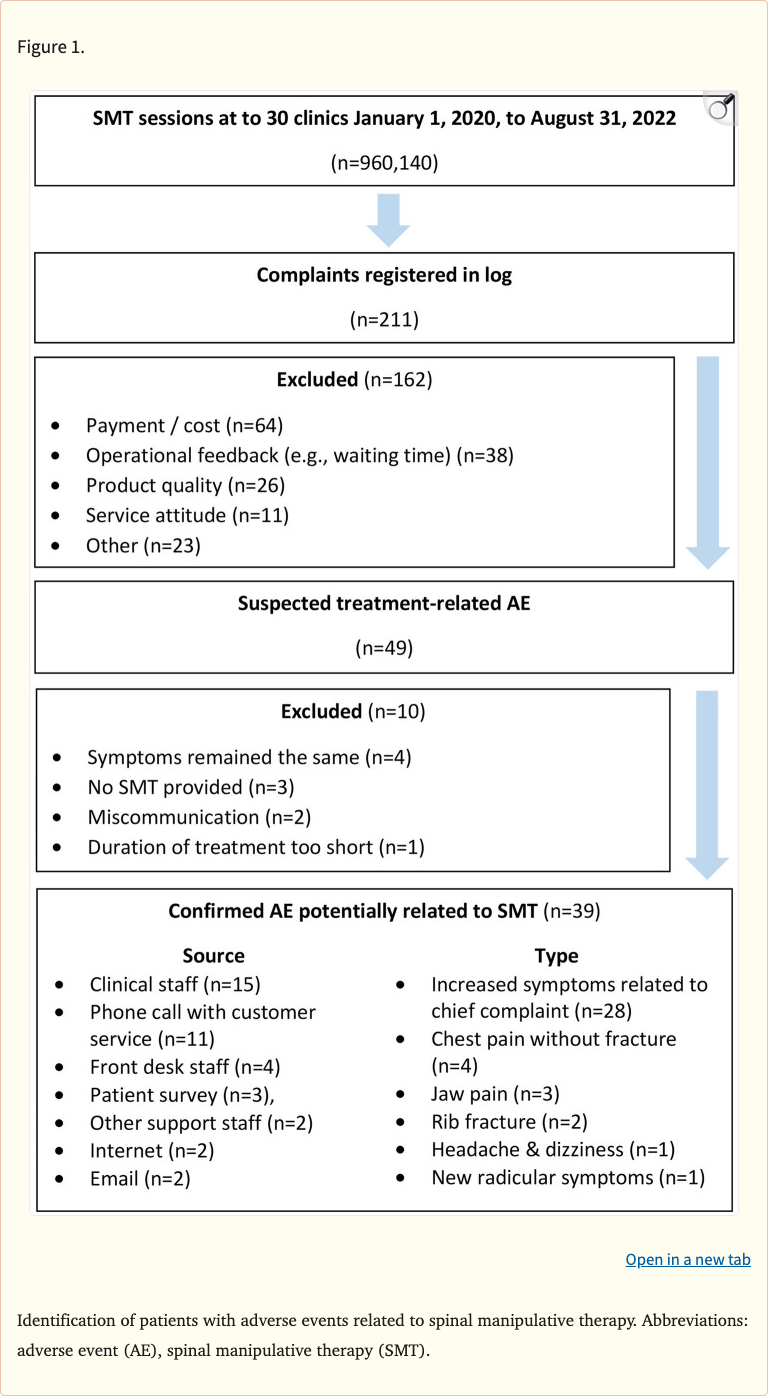 Figure 1
Limitations
Retrospective design limits ability to establish causation. Adverse events may be underreported in clinical records. No control group for comparison of baseline event rates. Self-reported outcomes subject to recall bias. Dataset from specific practice settings may not generalize to all chiropractic practices. Rare events may still be underestimated despite large sample size. Temporal association does not prove causation, particularly for vascular events where patients may seek care for symptoms of pre-existing pathology.