Key Takeaway
BFR training offers athletes multiple applications including accelerated rehabilitation, hypertrophy maintenance during deload phases, and supplemental training with reduced mechanical stress.
Summary
This narrative review examines where blood flow restriction fits within the broader context of athletic development and performance optimization. Rather than treating BFR as a standalone training method, the authors analyze its potential role as a complementary tool alongside traditional heavy resistance training.
The review details the proposed mechanisms underlying BFR adaptations, including metabolic stress accumulation, cell swelling, and altered fiber recruitment patterns. Importantly, it addresses practical applications specific to athletic populations: using BFR during rehabilitation from injury, maintaining muscle mass during planned deload or taper phases, and supplementing heavy training with reduced joint stress.
The authors conclude that BFR is best viewed as one tool among many rather than a replacement for heavy training. Its value lies in specific contexts where traditional high-load training is impractical or contraindicated, making it particularly useful for managing training loads across a competitive season.
Methods
Narrative review synthesizing current evidence on BFR mechanisms and applications for athletic populations. Examined physiological mechanisms, acute responses, chronic adaptations, and practical implementation strategies. Drew from randomized trials, mechanistic studies, and applied research in athletic settings.
Key Results
- BFR mechanisms include metabolic stress, cell swelling, and altered motor unit recruitment
- Hypertrophy with BFR approaches that of heavy training despite 20-40% 1RM loads
- Strength gains more modest compared to heavy training but significant vs. control
- Key athletic applications: rehabilitation, deload maintenance, supplemental hypertrophy
- BFR can reduce mechanical stress while preserving training stimulus
- Best used as complement to, not replacement for, heavy resistance training
Figures
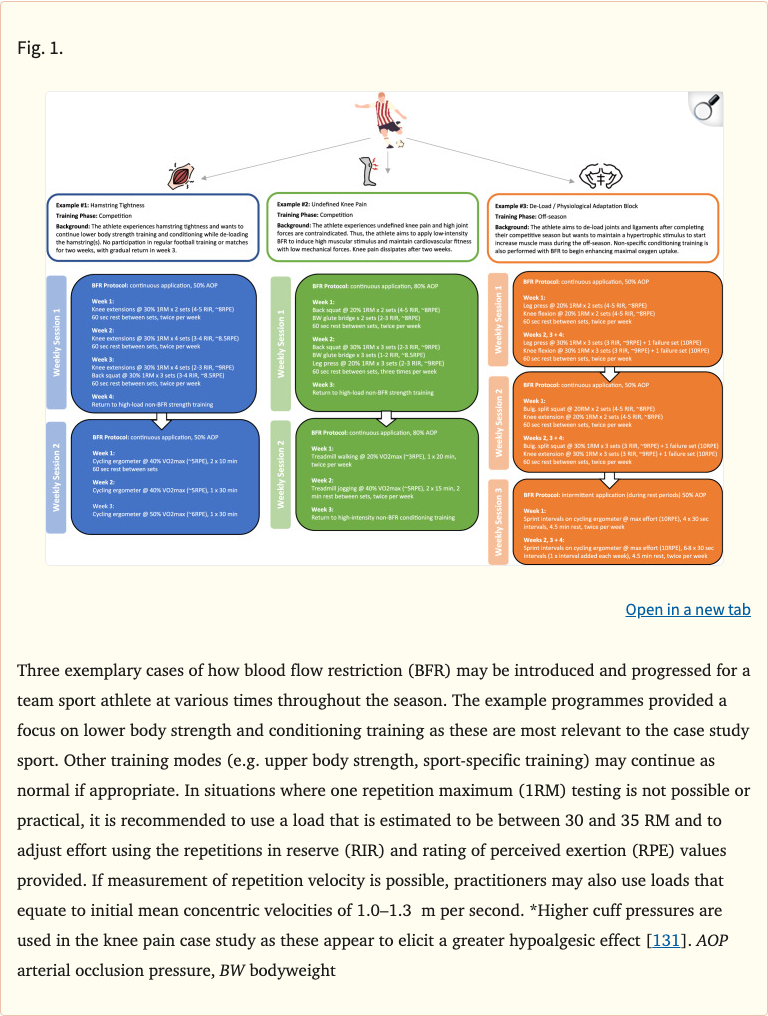 Figure 1
Limitations
- Narrative review format less rigorous than systematic review
- Limited direct evidence from elite athletic populations
- Optimal protocols for different sports/contexts not well established
- Long-term effects of regular BFR use in athletes not fully characterized
- Individual variability in BFR response not well addressed in literature
Related Interventions
Related Studies
Discussed In