
Key Takeaway
A 4-minute cyclic sighing exercise significantly reduced both pain unpleasantness and pain intensity in orthopedic clinic patients compared to a control condition.
Summary
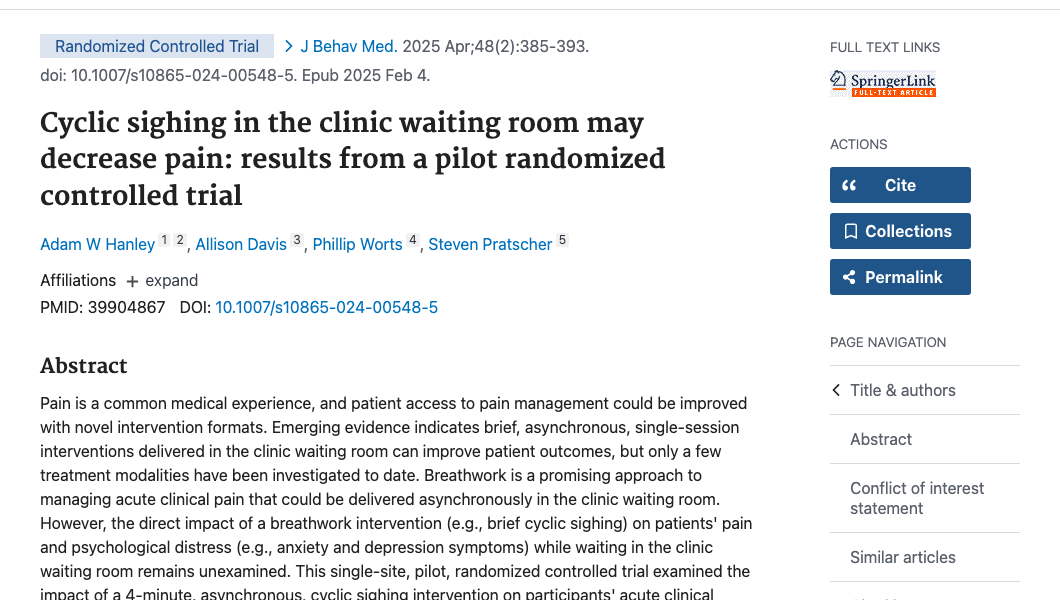
This pilot randomized controlled trial investigated whether a brief cyclic sighing intervention could reduce acute clinical pain in patients waiting for x-rays at a walk-in orthopedic clinic. Participants were randomized to either a 4-minute asynchronous cyclic sighing exercise or a time- and attention-matched injury management control condition.
The study found that participants who performed cyclic sighing reported significantly less pain unpleasantness and pain intensity while waiting for their x-ray compared to controls. However, anxiety and depression symptoms did not differ significantly between groups.
These results suggest that brief, asynchronous breathwork interventions like cyclic sighing could be a practical, low-cost tool for managing acute pain in clinical settings. The asynchronous format — requiring no therapist or facilitator — makes it particularly scalable for integration into clinic waiting rooms.
Methods
Single-site pilot RCT conducted in the x-ray waiting room of a walk-in orthopedic clinic. Participants were randomized to a 4-minute asynchronous cyclic sighing intervention or a time- and attention-matched injury management control condition. Outcomes measured included pain unpleasantness, pain intensity, anxiety symptoms, and depression symptoms. The study was registered as NCT06292793.
Key Results
- Cyclic sighing group reported significantly lower pain unpleasantness vs. controls
- Cyclic sighing group reported significantly lower pain intensity vs. controls
- No significant between-group differences in anxiety or depression symptoms
- Effects observed after just 4 minutes of practice
Limitations
- Pilot study with relatively small sample size
- Single-site design limits generalizability
- Short-term assessment only (immediate post-intervention)
- Self-reported outcome measures
- Orthopedic pain population may not generalize to other pain types
- No long-term follow-up to assess durability of effects