
Key Takeaway
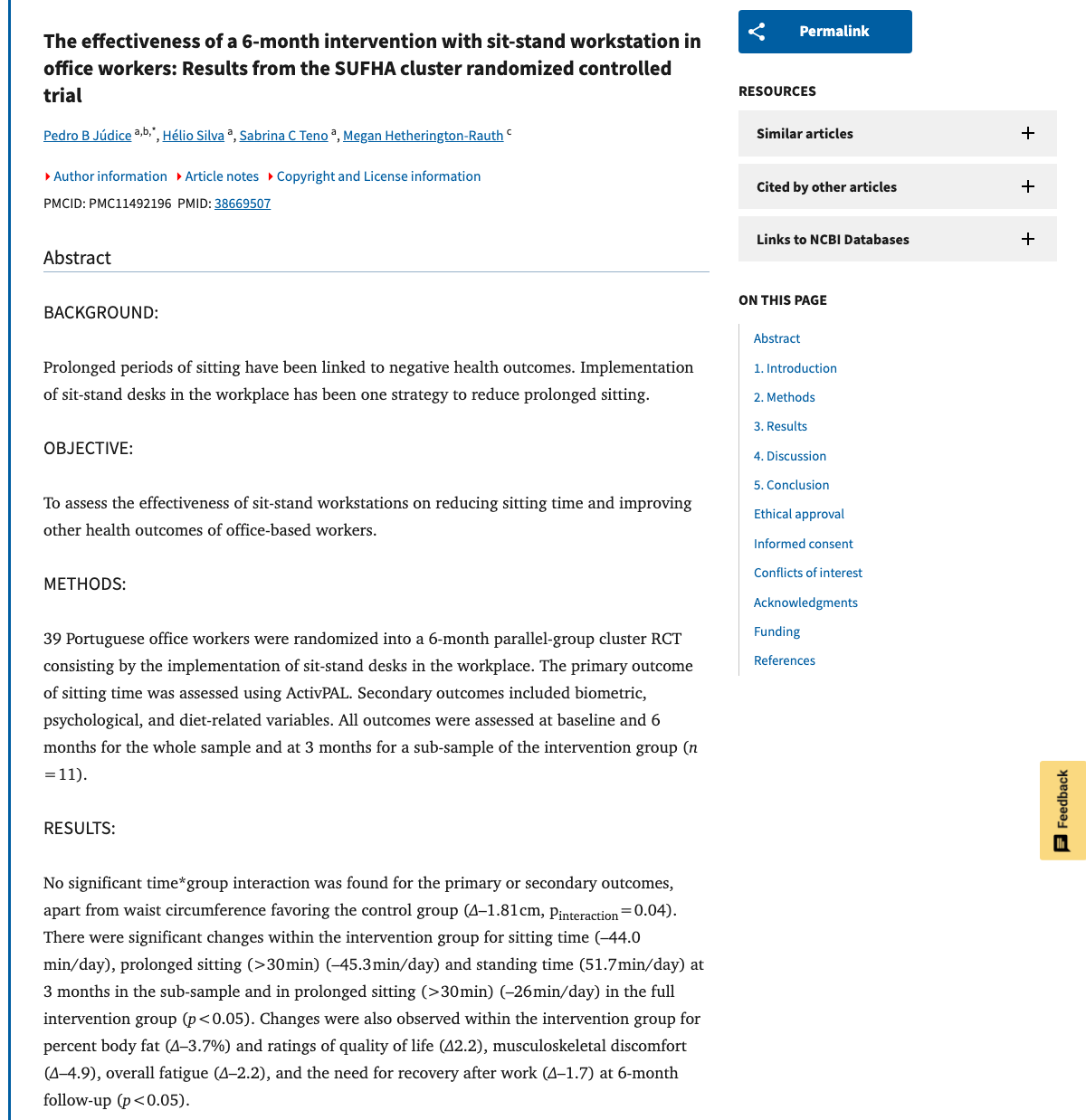
A 6-month cluster RCT found that sit-stand workstations significantly reduced occupational sitting time and improved cardiometabolic markers in office workers.
Summary
This cluster RCT (the SUFHA study) evaluated sit-stand workstations over 6 months in a real-world office setting. Intervention groups received height-adjustable desks and behavioral coaching.
Participants showed significant reductions in occupational sitting time and improvements in cardiometabolic risk markers including waist circumference and blood pressure.
The 6-month duration and cluster-randomized design provide stronger evidence than most prior short-term trials. Adherence remained reasonable throughout.
Methods
- Cluster randomized controlled trial
- 6-month intervention in office workplaces
- Sit-stand workstation + coaching vs. standard desks
- Objective sitting time measurement via accelerometry
- Cardiometabolic outcomes assessed
Key Results
- Significant reduction in occupational sitting time
- Improvements in waist circumference and blood pressure
- Reasonable adherence over 6 months
- No adverse effects reported
Limitations
- Cluster randomization may introduce confounding
- Coaching component hard to isolate from desk effect
- Individual variation in usage patterns
- Single geographic population
