
Key Takeaway
Combined resistance and aerobic training at least 3x/week for 4+ weeks produces large improvements in load carriage performance, with progressive load-carriage exercise itself being the most effective training mode.
Summary
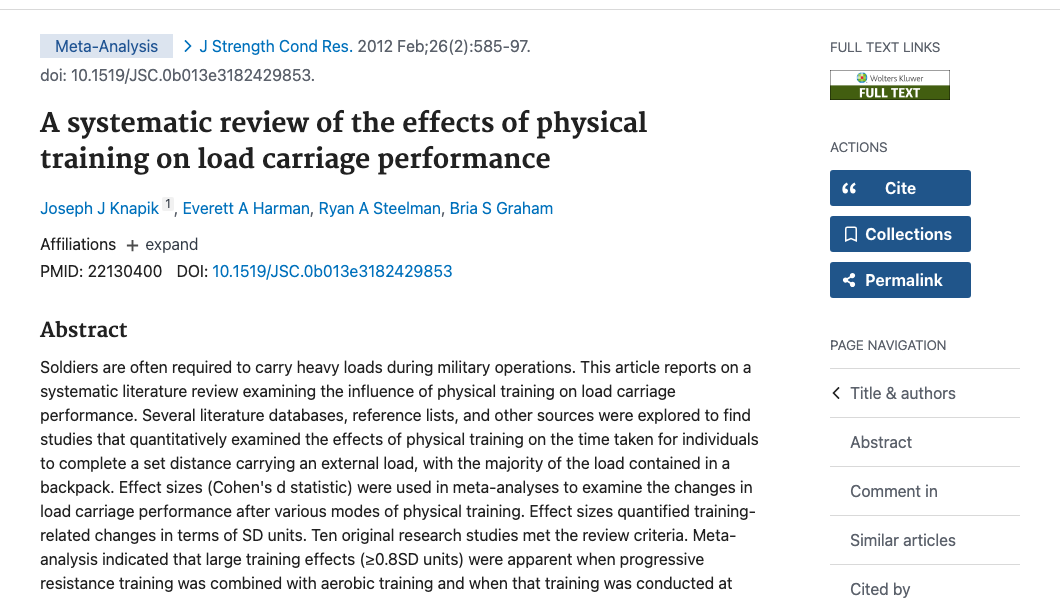
This systematic review and meta-analysis from the U.S. Army Institute of Public Health examined how different physical training approaches affect soldiers' ability to carry heavy loads over set distances. The investigators searched multiple databases and reference lists to locate quantitative studies that measured load carriage performance, primarily carrying external loads in backpacks.
The meta-analysis used Cohen's d effect sizes to compare training outcomes across studies. Programs combining progressive resistance training with aerobic training, performed at least 3 times per week over at least 4 weeks, produced large training effects (0.8 or more standard deviation units). Critically, programs that incorporated progressive load-carriage exercise itself showed the largest improvements, with a summary effect size of 1.7 SD units.
Field-based training that combined diverse exercise modes with progressive load-carriage work was also highly effective (1.1 SD units). In contrast, aerobic training alone or resistance training alone demonstrated smaller and more variable effects. The findings underscore that the principle of specificity applies strongly to load carriage -- training under load produces the best adaptations for carrying load.
While the research was conducted in military populations, the principles translate directly to civilian rucking: combining regular loaded walking with general strength and aerobic conditioning is the most effective approach for improving rucking performance.
Methods
- Systematic literature search across multiple databases and reference lists
- Included quantitative studies measuring time to complete set distances while carrying external loads (primarily backpacks)
- Used Cohen's d statistic effect sizes for meta-analyses
- Analyzed training-related changes measured in standard deviation units
- Compared different training modalities: resistance training, aerobic training, combined training, and progressive load carriage exercise
Key Results
- Combined resistance + aerobic training (3x/week, 4+ weeks) produced large effects (>=0.8 SD units)
- Progressive load-carriage exercise showed the largest improvements (summary effect size = 1.7 SD units)
- Field-based training combining diverse modes with progressive load carriage was highly effective (1.1 SD units)
- Aerobic training alone showed smaller, more variable effects
- Resistance training alone showed smaller, more variable effects
- Specificity of training was the strongest predictor of load carriage improvement
Limitations
- Most studies conducted in military populations (young, fit soldiers)
- Heterogeneity in study designs, load weights, distances, and training protocols
- Limited civilian population data
- Publication bias possible in military research literature
- Optimal training variables (load, frequency, duration) for different fitness levels not fully resolved