
Key Takeaway
A 5-year weighted vest plus jumping exercise program preserved hip bone mineral density in postmenopausal women, with exercisers gaining 1.5% at the femoral neck while controls lost 4.4%.
Summary
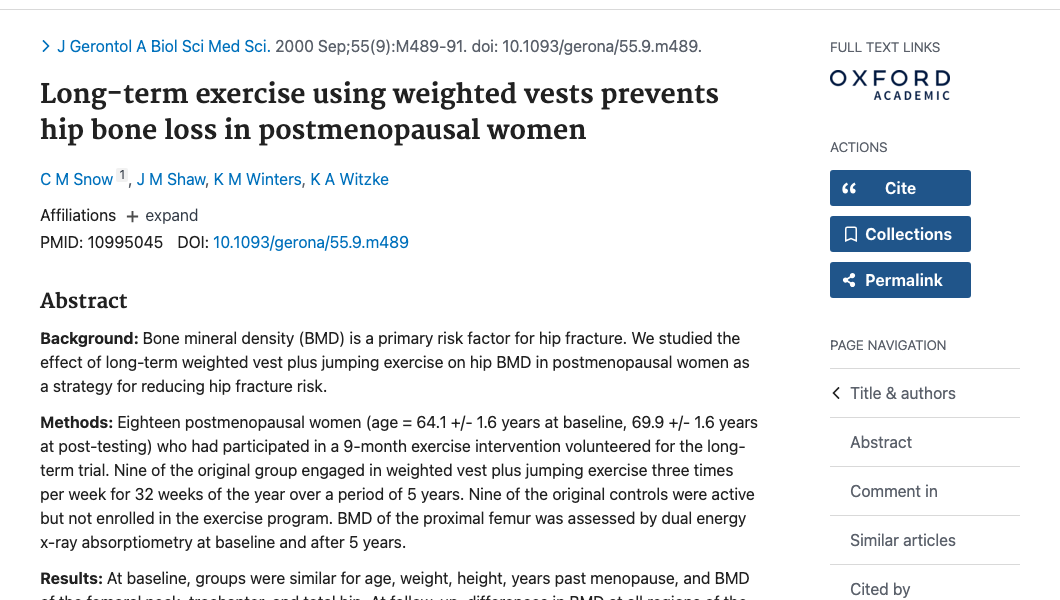
This randomized controlled trial investigated whether long-term weighted vest exercise could prevent hip bone loss in postmenopausal women -- a critical question given that bone mineral density (BMD) is a primary risk factor for hip fracture. Eighteen postmenopausal women were assigned to either a weighted vest plus jumping exercise group or an active control group and followed for 5 years.
The exercise group performed weighted vest plus jumping exercises three times per week, 32 weeks per year, over the 5-year study period. At follow-up, exercisers showed a 1.54% increase in femoral neck BMD, while control subjects experienced a 4.43% decrease at the same site. Differences in BMD at all regions of the hip were higher in the exercise group compared to controls.
These results are particularly relevant for rucking because they demonstrate that weighted exercise -- adding external load to movement -- provides a meaningful bone-preserving stimulus. The weighted vest protocol shares the core mechanism of rucking: imposing additional mechanical load on the skeleton during weight-bearing activity. The 5-year duration and sustained adherence also suggest that weighted exercise is a practical long-term strategy.
The finding that weighted exercise not only prevented bone loss but actually maintained or slightly increased BMD over 5 years is notable. For postmenopausal women at risk of osteoporosis, rucking offers a similar weight-bearing stimulus that could help preserve bone density alongside its cardiovascular and strength benefits.
Methods
- Randomized controlled trial with 18 postmenopausal women
- 9 assigned to weighted vest + jumping exercise, 9 active controls
- Exercise performed 3 times per week, 32 weeks per year
- 5-year follow-up duration
- Proximal femur BMD measured by dual energy x-ray absorptiometry (DEXA) at baseline and follow-up
- Measured BMD at femoral neck and other hip regions
Key Results
- Exercise group: +1.54% femoral neck BMD over 5 years
- Control group: -4.43% femoral neck BMD over 5 years
- BMD at all hip regions was higher in exercisers vs controls at follow-up
- Sustained exercise adherence over the 5-year study period
- Weighted vest exercise maintained hip BMD by preventing significant bone loss
Limitations
- Very small sample size (n=18 total, 9 per group)
- Exercise protocol included jumping in addition to weighted vest (cannot isolate vest effect alone)
- Active controls may have attenuated between-group differences
- 32 weeks/year of exercise (not year-round)
- Single-site study at one institution
- Primarily white postmenopausal women -- limited generalizability