
Key Takeaway
Walking with a weighted vest at 10-20% of body mass significantly increases metabolic cost, exercise intensity, and skeletal loading compared to unweighted walking, with effects scaling with both vest weight and walking speed.
Summary
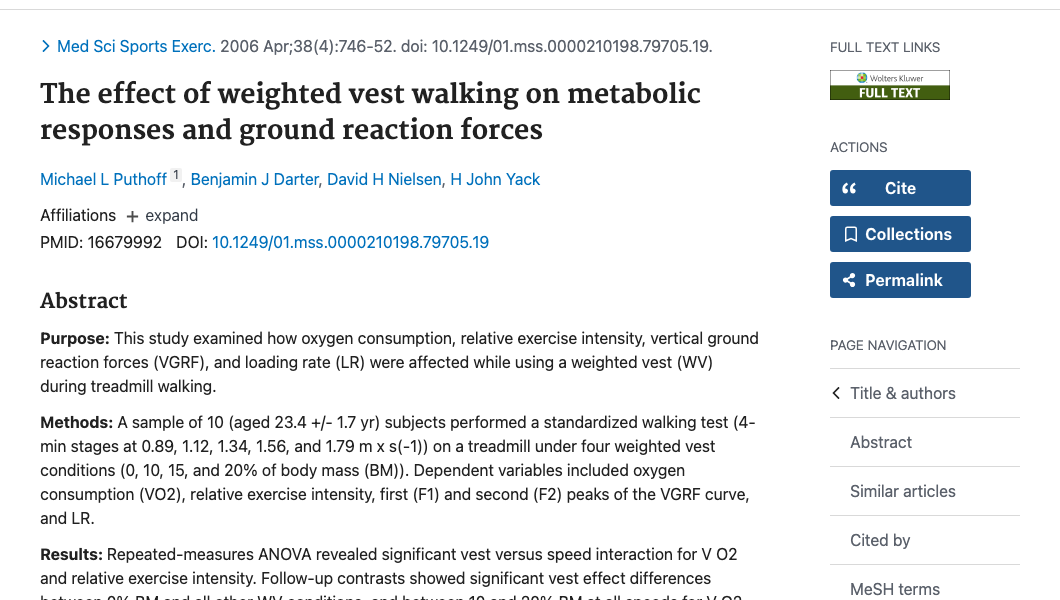
This crossover study examined how weighted vest walking affects oxygen consumption, relative exercise intensity, vertical ground reaction forces (VGRF), and loading rate during treadmill walking. Ten young adults walked at five standardized speeds (0.89 to 1.79 m/s) while wearing weighted vests at 0%, 10%, 15%, and 20% of body mass.
The results showed significant interactions between vest weight and walking speed for both oxygen consumption and relative exercise intensity. As vest weight increased, metabolic demands rose proportionally -- meaning the same walking pace burns meaningfully more calories with added weight. Ground reaction force peaks also increased significantly with heavier vests, and loading rates at 15% and 20% body mass were notably higher than unweighted conditions.
These findings quantify the dual benefit of rucking: it increases both the cardiovascular/metabolic stimulus and the mechanical loading on the skeletal system during a low-impact activity. The 10-20% body mass range tested is directly relevant to typical civilian rucking loads (a 180-lb person carrying 18-36 lbs).
The study provides biomechanical evidence that weighted walking increases skeletal loading without the impact forces seen in running. This makes rucking an attractive option for improving both cardiovascular fitness and bone health simultaneously, particularly for populations who want more intensity than regular walking but want to avoid high-impact exercise.
Methods
- Crossover design with 10 healthy young adults (mean age 23.4 years)
- Standardized treadmill walking at 5 speeds: 0.89, 1.12, 1.34, 1.57, and 1.79 m/s
- Weighted vest conditions: 0% (unweighted), 10%, 15%, and 20% of body mass
- Measured oxygen consumption (VO2) and relative exercise intensity
- Measured vertical ground reaction forces (VGRF) and loading rates
- Each participant served as their own control across all conditions
Key Results
- Significant interactions between vest weight and walking speed for oxygen consumption and exercise intensity
- Metabolic cost increased proportionally with vest weight at all speeds
- Ground reaction force peaks (F1 and F2) increased significantly with heavier vests
- Loading rates at 15% and 20% body mass significantly higher than unweighted walking
- Weighted vest walking increases both metabolic costs and skeletal system loading
- Effects scale with both vest weight and walking speed
Limitations
- Small sample size (n=10)
- Young healthy adults only (mean age ~23) -- may not generalize to older populations
- Treadmill walking only -- outdoor terrain effects not captured
- Acute measurements -- no long-term training adaptation data
- Weighted vest (torso loading) differs biomechanically from backpack loading
- Short walking bouts -- does not capture fatigue effects over longer durations