
Key Takeaway
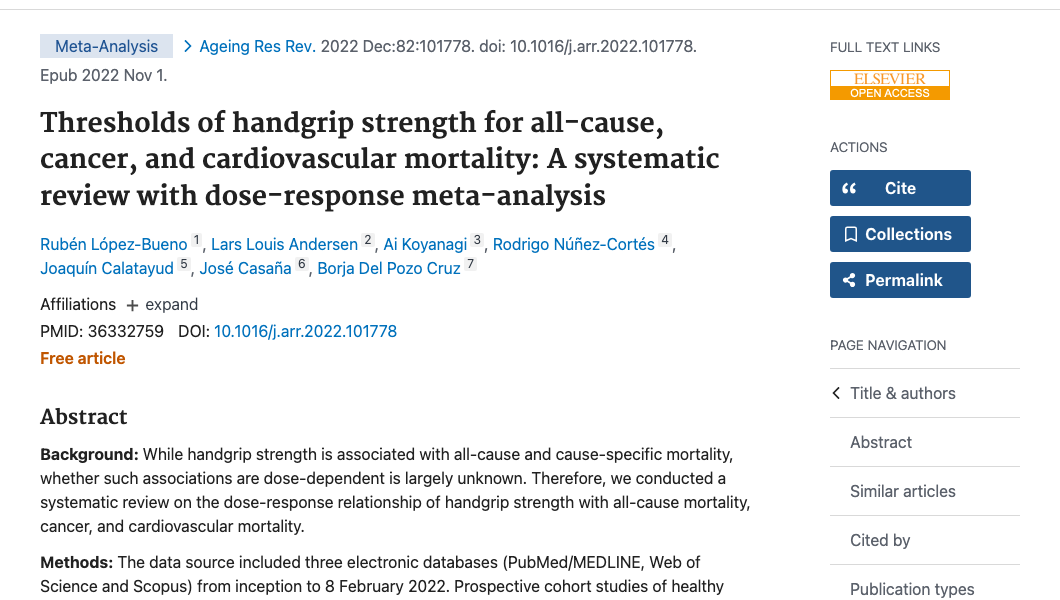
Dose-response meta-analysis of 48 studies (3.1M participants) found significant reductions in all-cause, cardiovascular, and cancer mortality at handgrip strength thresholds of 26-50 kg.
Summary
This systematic review with dose-response meta-analysis examined the relationship between handgrip strength and mortality from all causes, cardiovascular disease, and cancer. The authors pooled data from 48 studies encompassing over 3.1 million participants to determine whether specific grip strength thresholds exist beyond which mortality risk meaningfully decreases. The analysis revealed a clear dose-response relationship: as handgrip strength increased, mortality risk decreased in a non-linear fashion. Significant risk reductions were observed at grip strength levels between 26 and 50 kg, with the protective effect plateauing at higher values. This pattern held for all-cause, cardiovascular, and cancer mortality outcomes. These findings reinforce handgrip strength as a powerful, easily measured biomarker for overall health and longevity, and suggest that even modest improvements in grip strength within the identified thresholds could meaningfully reduce mortality risk.
Methods
Systematic review and dose-response meta-analysis following PRISMA guidelines. Searched PubMed, Web of Science, and Scopus through 2022. Included 48 prospective cohort studies with a combined 3.1 million participants. Used restricted cubic splines to model non-linear dose-response relationships between handgrip strength (measured in kg) and all-cause, cardiovascular, and cancer mortality. Risk of bias assessed using the Newcastle-Ottawa Scale.
Key Results
- 48 studies with 3.1 million total participants included
- Clear non-linear dose-response relationship between grip strength and mortality
- Significant all-cause mortality risk reduction at grip strength of 27 kg (women) and 37-50 kg (men)
- Cardiovascular mortality risk decreased significantly at similar thresholds
- Cancer mortality also showed significant dose-response reduction
- Protective effect plateaued at higher grip strength values, suggesting a ceiling beyond which additional strength provides diminishing returns
Limitations
- Most included studies were observational cohort designs, limiting causal inference
- Heterogeneity in grip strength measurement protocols across studies
- Limited data on younger populations; most participants were middle-aged or older
- Could not fully account for reverse causation (illness reducing grip strength)
- Thresholds may vary by ethnicity and body composition, which were not fully explored