
Key Takeaway
Systematic review of 3M+ participants confirmed grip strength reliably predicts all-cause and cause-specific mortality, with standardized measurement protocols (dominant hand, maximum of multiple trials) critical for accurate risk assessment.
Summary
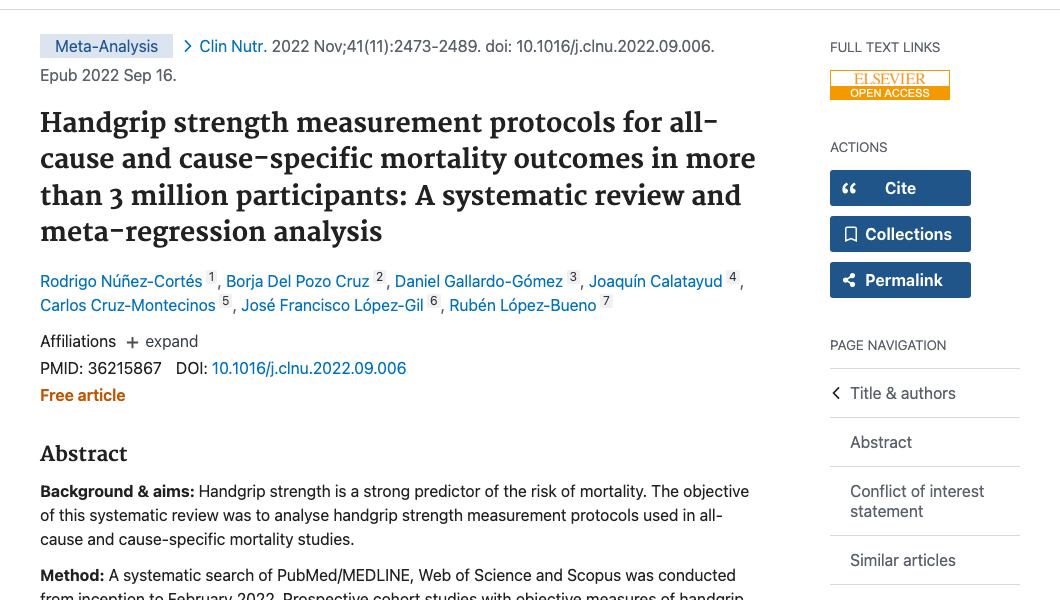
This systematic review and meta-regression analysis examined how different handgrip strength measurement protocols affect the association between grip strength and mortality outcomes. With over 3 million participants across the included studies, this is one of the largest analyses addressing methodological consistency in grip strength research. The authors found that grip strength was a robust predictor of all-cause, cardiovascular, cancer, and respiratory mortality regardless of measurement protocol. However, the strength of the association varied depending on factors like which hand was tested (dominant vs. non-dominant), the number of trials performed, and whether the maximum or mean value was used. Protocols using the dominant hand and taking the maximum value from multiple trials showed the most consistent associations. The findings have important practical implications: standardized measurement protocols would improve comparability across studies and clinical settings, making grip strength testing more reliable as a screening tool for mortality risk in clinical practice.
Methods
Systematic review and meta-regression analysis following PRISMA guidelines. Searched major databases for prospective cohort studies reporting handgrip strength and mortality. Catalogued measurement protocols across studies including: dynamometer type, hand tested (dominant, non-dominant, both), number of trials, rest intervals, body position, and summary metric (maximum, mean). Used meta-regression to determine whether protocol differences moderated the grip strength-mortality association. Analyzed all-cause, cardiovascular, cancer, and respiratory mortality separately.
Key Results
- Over 3 million participants across all included studies
- Grip strength predicted all-cause mortality across all measurement protocols
- Cardiovascular, cancer, and respiratory mortality were also significantly associated
- Dominant hand measurements showed more consistent mortality associations
- Using the maximum value from multiple trials provided strongest associations
- Meta-regression revealed that protocol variation partially explained heterogeneity across studies
- Jamar dynamometer was the most commonly used device
Limitations
- Could not mandate a single optimal protocol from the available evidence
- Many studies did not fully report their measurement procedures
- Observational study designs limit causal inference
- Unable to assess how protocol standardization would affect clinical decision-making
- Population differences (age, sex, ethnicity) may interact with protocol effects
- Limited studies on cause-specific mortality compared to all-cause mortality analyses