
Key Takeaway
Meta-analysis found whole-body vibration training significantly improved leg muscle strength in elderly adults, with effects comparable to traditional resistance training in sedentary older populations.
Summary
This meta-analysis examined the effects of whole-body vibration (WBV) training on muscle strength and power in elderly populations. The researchers pooled data from randomized controlled trials to determine whether WBV represents an effective training modality for older adults.
The analysis found that WBV produced significant improvements in lower extremity strength, with effect sizes comparable to those seen with traditional resistance training in similar populations.
Methods
- Systematic review and meta-analysis
- Included RCTs of WBV in adults aged 60+
- Compared WBV to control or other exercise interventions
- Primary outcomes: leg muscle strength, power, balance
- Effect sizes calculated using standardized mean differences
- Random-effects model for pooled analysis
Key Results
- Significant improvement in leg muscle strength (ES = 0.69, 95% CI 0.29-1.08)
- Knee extensor strength improved most consistently
- Power output showed moderate improvements
- Balance measures improved in most studies
- Effects comparable to traditional resistance training in untrained elderly
- Training frequency of 2-3x/week for 6-12 weeks typical
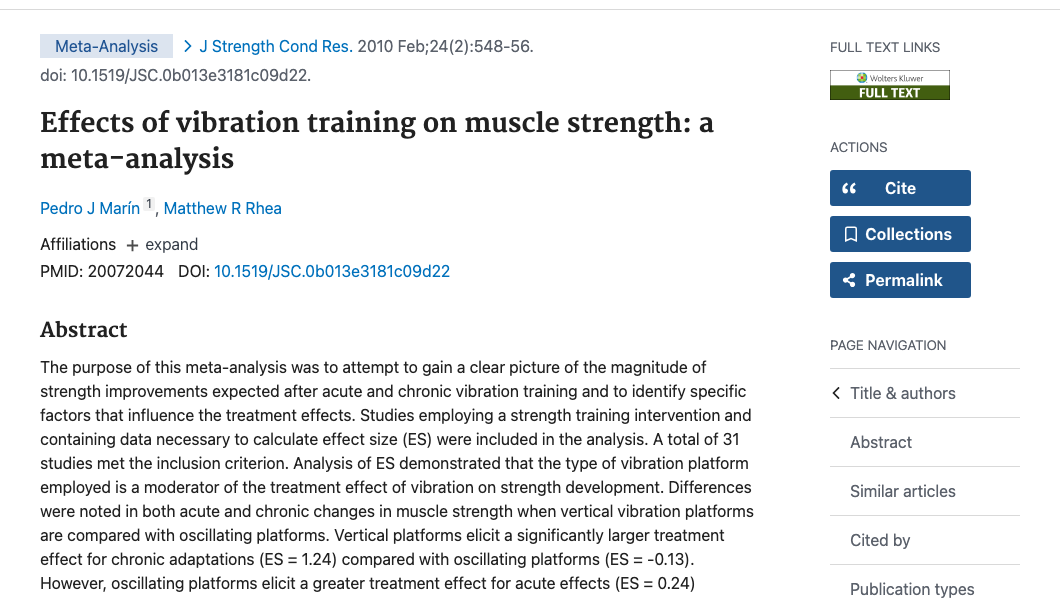
- Vertical vibration platforms showed stronger effects than oscillating types
Limitations
- Heterogeneity in WBV protocols (frequency, amplitude, duration)
- Most studies included untrained/sedentary participants
- Limited comparison to optimized resistance training
- Short intervention periods in most studies
- Functional outcomes (falls, ADLs) rarely assessed
- May not apply to already-trained older adults