
Key Takeaway
taVNS produced a small but significant improvement in cognitive performance (g = 0.21) across 19 studies, with executive function and tragus stimulation showing the strongest effects.
Summary
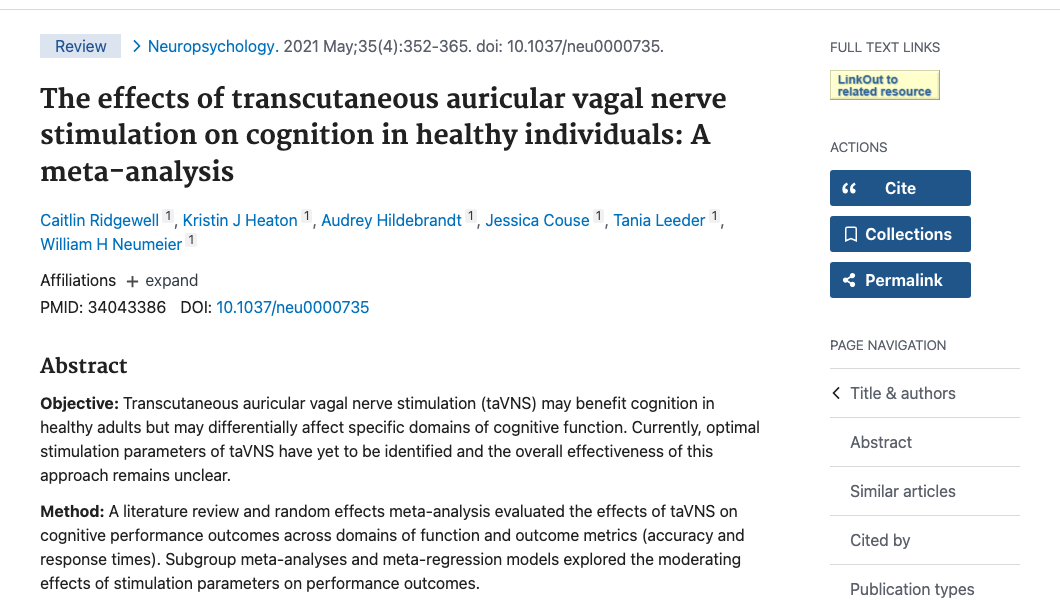
This meta-analysis examined whether transcutaneous auricular vagus nerve stimulation (taVNS) can enhance cognitive performance in healthy individuals. The authors conducted a literature review and random-effects meta-analysis of 19 eligible studies, evaluating cognitive outcomes across multiple functional domains using both accuracy and response time measures.
The pooled analysis found a small but significant weighted effect size of g = 0.21 for overall cognitive performance, with executive function and accuracy-based measures showing the most meaningful improvements. Notably, stimulation parameters had a major influence on outcomes: tragus stimulation produced substantially larger effects (g = 2.39) compared to cymba concha stimulation (g = 0.48), a difference that was statistically significant in meta-regression analysis (Q = 39.84, p < .0001).
These findings suggest taVNS has genuine potential as a cognitive enhancement tool in healthy populations, particularly for executive function. However, the large variation in effect sizes depending on stimulation site highlights that protocol standardization is critical. The authors emphasized the need for continued research to identify optimal stimulation parameters before taVNS can be reliably recommended for cognitive enhancement.
Methods
- Literature review and random-effects meta-analysis
- 19 eligible studies included
- Evaluated cognitive performance across multiple functional domains
- Assessed both accuracy measures and response time metrics
- Meta-regression analysis to evaluate influence of stimulation parameters
- Compared stimulation sites (tragus vs cymba concha)
Key Results
- Overall weighted effect size of g = 0.21 for cognitive performance
- Executive function and accuracy measures showed significant improvements
- Tragus stimulation: g = 2.39 (substantially larger effect)
- Cymba concha stimulation: g = 0.48
- Stimulation site was the most influential parameter (Q = 39.84, p < .0001)
- Response time metrics did not show significant improvements
Limitations
- Relatively small number of studies (19) with varying sample sizes
- Large heterogeneity in stimulation parameters across studies
- Limited to healthy individuals - may not generalize to clinical populations
- Short-term cognitive effects only - no long-term follow-up data
- Publication bias possible given the emerging nature of the field