
Key Takeaway
taVNS significantly reduced depression scores across 12 RCTs (838 participants), with response rates comparable to antidepressants but fewer side effects.
Summary
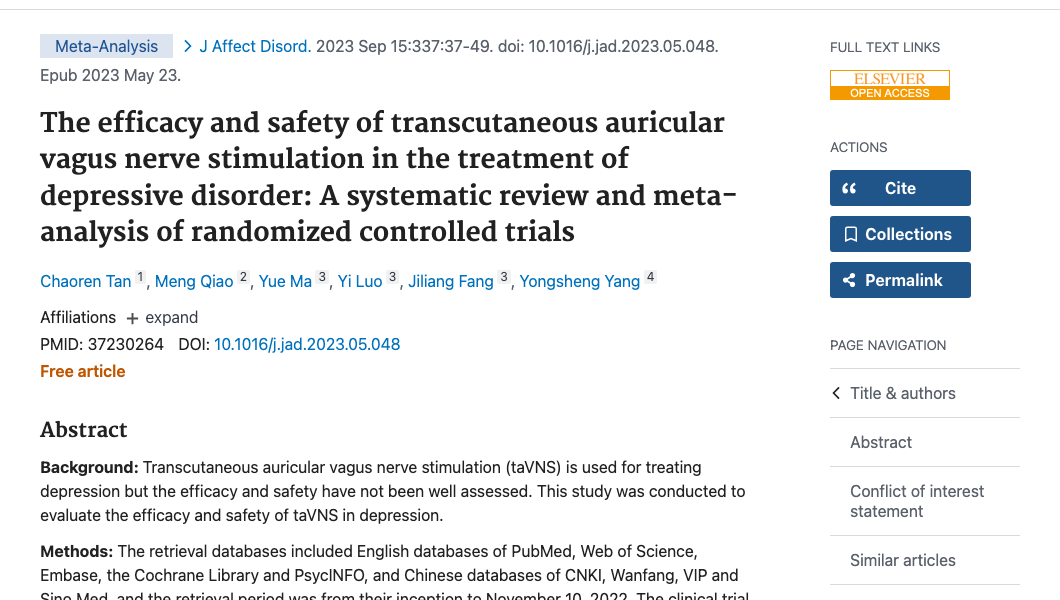
This systematic review and meta-analysis evaluated the efficacy and safety of transcutaneous auricular vagus nerve stimulation (taVNS) for treating depressive disorder. The authors searched nine databases including PubMed, Embase, Cochrane Library, and several Chinese databases through November 2022, identifying 12 randomized controlled trials with 838 total participants.
The pooled analysis found that taVNS significantly improved depression scores and reduced Hamilton Depression Scale (HAMD) ratings compared to sham stimulation. Response rates for taVNS were higher than sham-taVNS and comparable to antidepressants alone. Notably, the combination of taVNS plus antidepressants showed similar efficacy to antidepressants alone but with fewer reported side effects, suggesting taVNS may serve as a useful adjunct therapy.
The overall quality of evidence was rated low to very low across subgroups, reflecting the relatively small number of studies and participants in each comparison. Nevertheless, the authors concluded that taVNS is an effective and safe method for alleviating depression, with a favorable side-effect profile compared to pharmacological treatment.
Methods
- Systematic search of 9 databases (PubMed, Web of Science, Embase, Cochrane, PsycINFO, CNKI, Wanfang, VIP, Sino Med) through November 2022
- Included randomized controlled trials of taVNS for depressive disorder
- Also searched ClinicalTrials.gov and Chinese Clinical Trial Registry
- 12 RCTs with 838 participants included
- Subgroup analyses comparing taVNS vs sham, taVNS vs antidepressants, and taVNS + antidepressants vs antidepressants alone
- Evidence quality assessed using GRADE framework
Key Results
- taVNS significantly improved depression scores and reduced HAMD ratings vs sham stimulation
- taVNS response rates were higher than sham-taVNS
- taVNS response rates were comparable to antidepressants (ATD)
- taVNS + ATD showed comparable efficacy to ATD alone but with fewer side effects
- taVNS was well-tolerated with a favorable safety profile
Limitations
- Evidence quality rated low to very low across subgroups
- Relatively small number of RCTs (12 studies)
- Small sample sizes in individual subgroup analyses
- Heterogeneity in stimulation parameters across studies
- Inclusion of Chinese-language databases may limit reproducibility of search