Key Takeaway
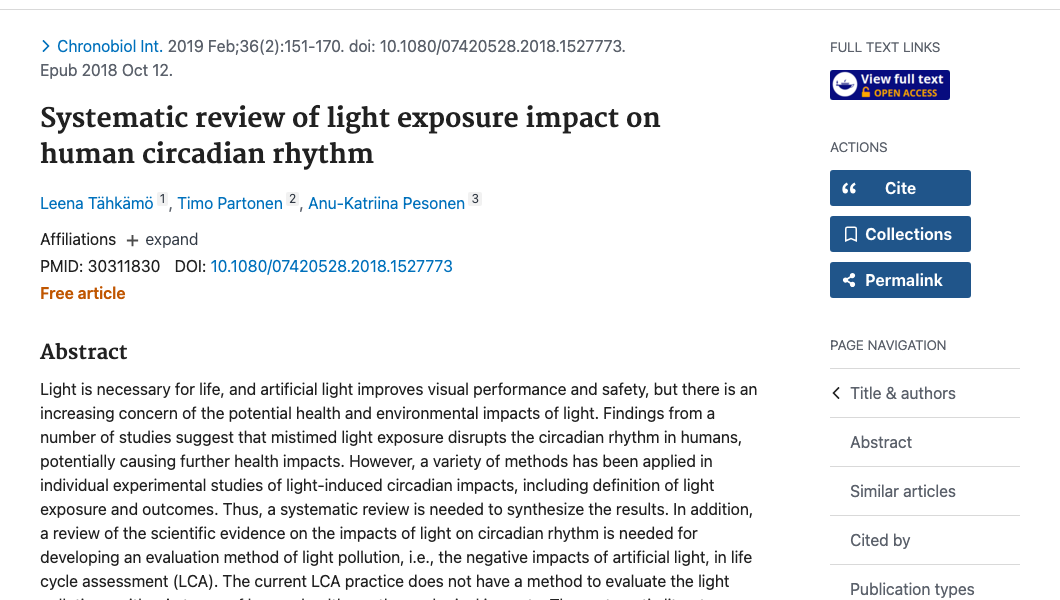
Systematic review of 15 high-quality studies confirmed that 2-hour evening blue light exposure (460 nm) suppresses melatonin, with maximum suppression at 424 nm, providing the mechanistic basis for blue-blocking glasses.
Summary
This systematic review examined how artificial light exposure affects human circadian rhythm, focusing specifically on melatonin secretion and REM sleep as key markers. The review provides the scientific foundation for why blue-blocking glasses may be beneficial by quantifying how different wavelengths of light impact the circadian system.
The authors screened 128 articles and applied strict quality criteria requiring a minimum sample size of 20 subjects and detailed light exposure specifications (spectrum, wavelength, illuminance). This resulted in 15 high-quality studies for in-depth analysis.
Key findings included that a 2-hour exposure to blue light (460 nm) in the evening significantly suppresses melatonin production, with maximum suppression occurring at even shorter violet wavelengths (424 nm). Importantly, melatonin recovered rapidly - within 15 minutes of light exposure cessation. The review also revealed that even red light (631 nm) and low-intensity exposure (5-10 lux) can induce some circadian responses, though the effect is much smaller than blue light.
The review also found that light-induced circadian phase advancement remains unimpaired with aging, though the magnitude of melatonin suppression decreases with age. These findings support the rationale for evening blue-light blocking as a strategy to protect melatonin production and preserve circadian rhythm integrity.
Methods
- Systematic literature review on light exposure and circadian rhythm
- Initial search yielded 128 articles on light, melatonin, and REM sleep
- Applied quality criteria: minimum 20 subjects, detailed light specifications (spectrum, wavelength, illuminance)
- 15 studies met inclusion criteria for in-depth analysis
- Assessed different wavelengths, intensities, and durations of light exposure
- Focused on melatonin secretion and REM sleep as primary circadian markers
Key Results
- 2-hour evening blue light (460 nm) exposure significantly suppresses melatonin
- Maximum melatonin suppression occurred at 424 nm (violet wavelength)
- Melatonin recovered rapidly within 15 minutes after light exposure stopped
- Even red light (631 nm) and low-intensity light (5-10 lux) induced some circadian responses
- Circadian phase advancement capacity is preserved with aging
- Melatonin suppression magnitude decreases with age
- Short-wavelength light has disproportionate impact on circadian system relative to luminous intensity
Limitations
- Strict inclusion criteria (n>=20) excluded many smaller but potentially informative studies
- Focused on controlled laboratory settings which may not reflect real-world light exposure patterns
- Did not directly test blue-blocking glasses as an intervention
- Limited to melatonin and REM sleep as circadian markers - other downstream health effects not assessed
- Heterogeneity in light exposure protocols across included studies
- Most studies used monochromatic light sources rather than the polychromatic light from screens and LEDs
Related Interventions
Related Studies
Discussed In