
Key Takeaway
Meta-analysis of 21 RCTs found dry cupping significantly reduced neck pain (MD -21.67) and low back pain (MD -19.38), with moderate evidence for improved functional status.
Summary
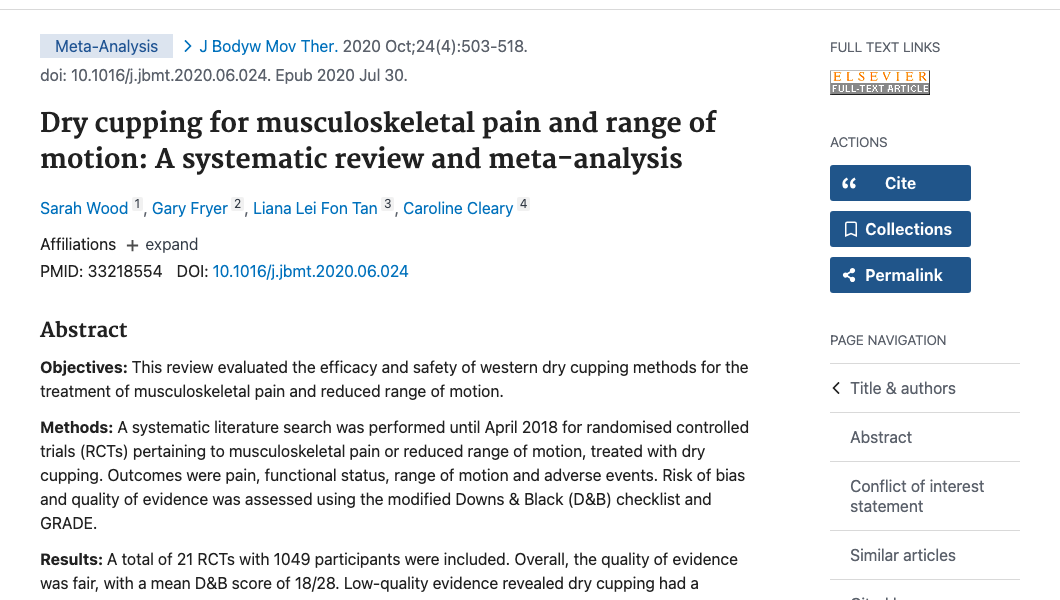
This systematic review and meta-analysis evaluated the effectiveness of dry cupping specifically (suction only, no incisions) for musculoskeletal pain and range of motion. The authors searched for RCTs through April 2018 and included 21 trials with a total of 1,049 participants.
The analysis found clinically meaningful pain reductions for both chronic neck pain (MD = -21.67 on a 100-point scale; 95% CI -36.55 to -6.80) and non-specific low back pain (MD = -19.38; 95% CI -28.09 to -10.66). Functional status in chronic neck pain also improved with moderate-quality evidence (MD = -4.65; 95% CI -6.44 to -2.85). Range of motion showed improvement compared to no treatment (SMD = -0.75), though evidence quality was low.
Overall study quality was fair, with a mean Downs and Black score of 18/28. The authors concluded that while dry cupping shows promise for musculoskeletal pain, definitive conclusions could not be drawn due to low-to-moderate quality evidence. They called for larger, higher quality trials with long-term follow-up and comprehensive adverse event reporting.
Methods
- Systematic review and meta-analysis of RCTs
- Literature search through April 2018
- Focused specifically on dry cupping (suction only)
- 21 RCTs with 1,049 participants included
- Quality assessed using modified Downs and Black checklist
- Evidence graded using GRADE methodology
- Outcomes: pain intensity, functional status, range of motion
Key Results
- Neck pain: significant reduction (MD = -21.67; 95% CI -36.55 to -6.80)
- Low back pain: significant reduction (MD = -19.38; 95% CI -28.09 to -10.66)
- Functional status (neck pain): moderate-quality improvement (MD = -4.65; 95% CI -6.44 to -2.85)
- Range of motion vs no treatment: significant improvement (SMD = -0.75)
- Mean study quality: 18/28 on Downs and Black checklist
Limitations
- Low to moderate quality of evidence overall
- Unable to make definitive conclusions about effectiveness
- Limited long-term follow-up data
- Inadequate adverse event reporting in most trials
- Blinding difficult for cupping interventions
