Key Takeaway
Both moderate-intensity continuous training (Zone 2) and HIIT equally improve VO2max in women, with more training sessions leading to greater gains.
Summary
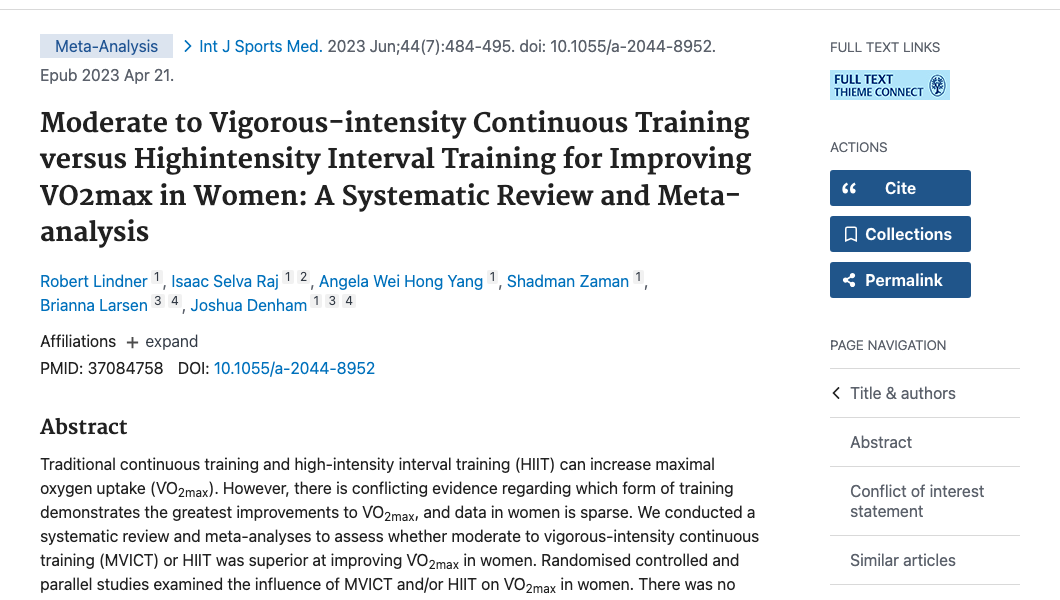
This systematic review and meta-analysis compared moderate to vigorous-intensity continuous training (MVICT) with high-intensity interval training (HIIT) for improving maximal oxygen uptake (VO2max) in women. The analysis included randomized controlled and parallel studies specifically examining female participants.
The study found no statistical difference in VO2max improvements between women in the MVICT and HIIT groups. Both training methods increased VO2max from baseline by approximately 3.2 ml/kg/min (p<0.001), demonstrating that moderate-intensity continuous training is just as effective as HIIT for improving aerobic capacity in women.
Interestingly, the number of training sessions was a key factor - greater improvements were observed in women who participated in more sessions regardless of training format. For HIIT specifically, longer interval protocols outperformed shorter ones. Age also played a role: while younger women showed greater gains with MVICT and long-HIIT compared to short-HIIT, these differences were negligible in older women, suggesting both approaches work well across age groups.
Methods
Systematic review and meta-analysis following PRISMA guidelines. Searched databases for randomized controlled and parallel studies comparing MVICT and/or HIIT on VO2max specifically in women. Subgroup analyses examined the effects of training frequency, HIIT protocol duration, and participant age.
Key Results
- No significant difference between MVICT and HIIT (MD: -0.42, 95%CI: -1.43 to 0.60, p>0.05)
- MVICT increased VO2max by 3.20 ml/kg/min (95% CI: 2.73 to 3.67, p<0.001)
- HIIT increased VO2max by 3.16 ml/kg/min (95% CI: 2.09 to 4.24, p<0.001)
- More training sessions correlated with greater improvements in both formats
- Long-HIIT protocols superior to short-HIIT for VO2max gains
- Age differences: younger women benefit more from MVICT and long-HIIT vs short-HIIT; older women showed similar responses to all protocols
Limitations
- Limited to studies with female participants only, reducing the overall sample size
- Heterogeneity in study designs and training protocols
- Variable definitions of what constitutes "moderate-intensity" vs "vigorous-intensity" training across studies
- Most studies conducted in controlled laboratory settings