
Key Takeaway
Bright light therapy is significantly more effective than placebo for treating SAD, with a small-to-medium effect size (SMD = -0.37) and a 42% higher response rate.
Summary
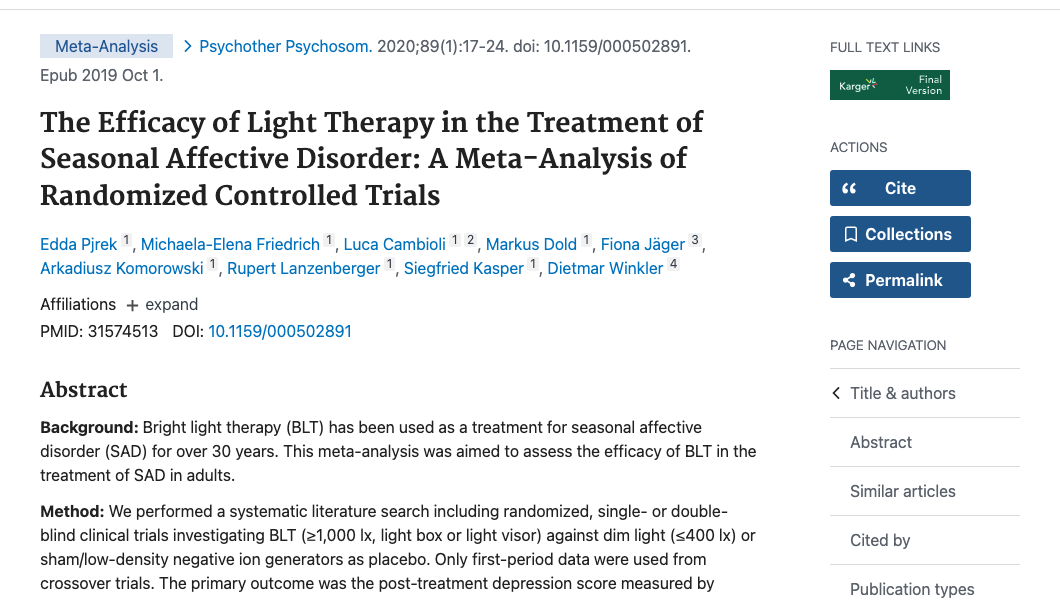
This meta-analysis pooled data from 19 randomized controlled trials involving 610 patients with Seasonal Affective Disorder to evaluate the efficacy of bright light therapy (BLT) compared to placebo conditions. It is one of the most comprehensive quantitative syntheses of the BLT evidence base for SAD.
The analysis found that BLT produced statistically significant improvements in depressive symptoms over control conditions, with a standardized mean difference of -0.37 (95% CI: -0.63 to -0.12). Patients receiving BLT were also 42% more likely to achieve a clinical response (risk ratio 1.42, 95% CI: 1.08-1.85). However, when stricter remission criteria were applied, the advantage was no longer statistically significant, suggesting BLT reliably reduces symptom severity but may not fully resolve depression in all patients.
The authors noted significant methodological heterogeneity across included trials, with many using small sample sizes and varying placebo conditions (dim light, deactivated ion generators, etc.). Despite these limitations, the overall direction of evidence clearly supports BLT as an effective treatment for SAD, consistent with its longstanding use in clinical practice.
Methods
Systematic search of PubMed, Cochrane Library, PsycINFO, and Embase for randomized controlled trials comparing bright light therapy to placebo or sham conditions in adults with SAD. Nineteen studies involving 610 participants met inclusion criteria. Effect sizes were calculated as standardized mean differences (SMD) using random-effects models. Response and remission rates were also analyzed using risk ratios.
Key Results
- BLT was significantly superior to placebo for reducing depressive symptoms (SMD = -0.37, 95% CI: -0.63 to -0.12, p = 0.004)
- Response rate significantly higher with BLT (risk ratio 1.42, 95% CI: 1.08-1.85)
- Remission rates showed a trend favoring BLT but did not reach statistical significance (risk ratio 1.38, 95% CI: 0.98-1.93)
- 19 RCTs with 610 total participants included
- Small-to-medium effect size consistent across sensitivity analyses
Limitations
- Significant heterogeneity across studies in treatment protocols, placebo conditions, and outcome measures
- Many included trials had small sample sizes, limiting statistical power
- Credible placebo conditions for light therapy are inherently difficult to design (patients may guess their assignment)
- Remission criterion not met at statistical significance, suggesting effects may be moderate rather than large
- Publication bias cannot be fully excluded given the small study sizes

