
Key Takeaway
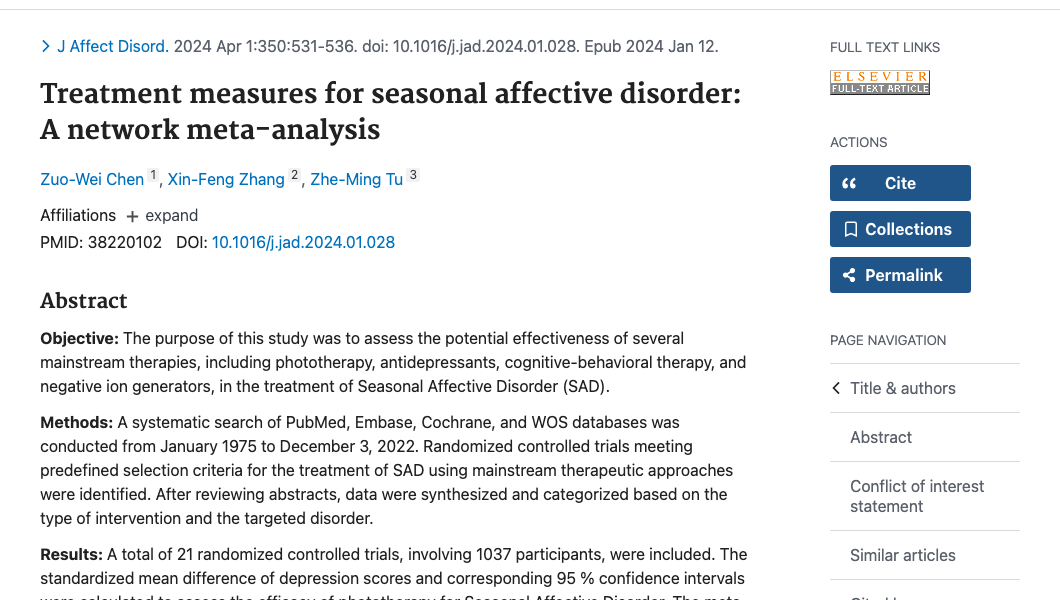
Network meta-analysis of 21 RCTs (1,037 participants) finds bright light therapy is a promising first-line non-pharmacological treatment for SAD, comparing favorably to antidepressants, CBT, and negative ion generators.
Summary
This network meta-analysis compared multiple treatment modalities for Seasonal Affective Disorder across 21 randomized controlled trials involving 1,037 participants. The treatments evaluated included bright light therapy (phototherapy), antidepressants (primarily SSRIs), cognitive behavioral therapy (CBT), and negative ion generators, allowing for both direct and indirect comparisons between interventions.
The analysis found that bright light therapy emerged as a promising first-line non-pharmacological treatment for SAD. By using network meta-analysis methodology, the authors could rank treatments even when head-to-head trials were limited, providing clinicians with a more comprehensive view of the treatment landscape. Bright light therapy demonstrated favorable efficacy with a lower side effect burden compared to pharmacological options.
This study is particularly valuable because it contextualizes light therapy within the broader SAD treatment toolkit. Rather than examining BLT in isolation, the network approach shows how it stacks up against medications and psychotherapy, supporting its position as an accessible, well-tolerated first-line option for patients with seasonal depression.
Methods
Systematic search for randomized controlled trials comparing any active treatment to control or another active treatment for SAD. Twenty-one RCTs with 1,037 participants were included. Network meta-analysis methodology was used to generate both direct and indirect comparisons between phototherapy, antidepressants, CBT, negative ion generators, and control conditions. Treatment rankings were calculated using surface under the cumulative ranking curve (SUCRA) probabilities.
Key Results
- 21 RCTs with 1,037 total participants included in the network
- Bright light therapy identified as a promising first-line non-pharmacological treatment
- Treatments compared: phototherapy, antidepressants, CBT, negative ion generators, and placebo/control
- Network analysis allowed ranking of treatments even without direct head-to-head comparisons for all pairs
- Bright light therapy showed favorable efficacy-to-tolerability ratio compared to pharmacological alternatives
Limitations
- Some treatment comparisons relied on indirect evidence rather than head-to-head trials
- Heterogeneity in study designs, treatment protocols, and outcome measures across the 21 included trials
- Relatively modest total sample size (1,037 participants) spread across multiple treatment arms
- Limited long-term follow-up data in most included studies
- Potential for inconsistency in the network due to varying study populations and SAD diagnostic criteria
