
Key Takeaway
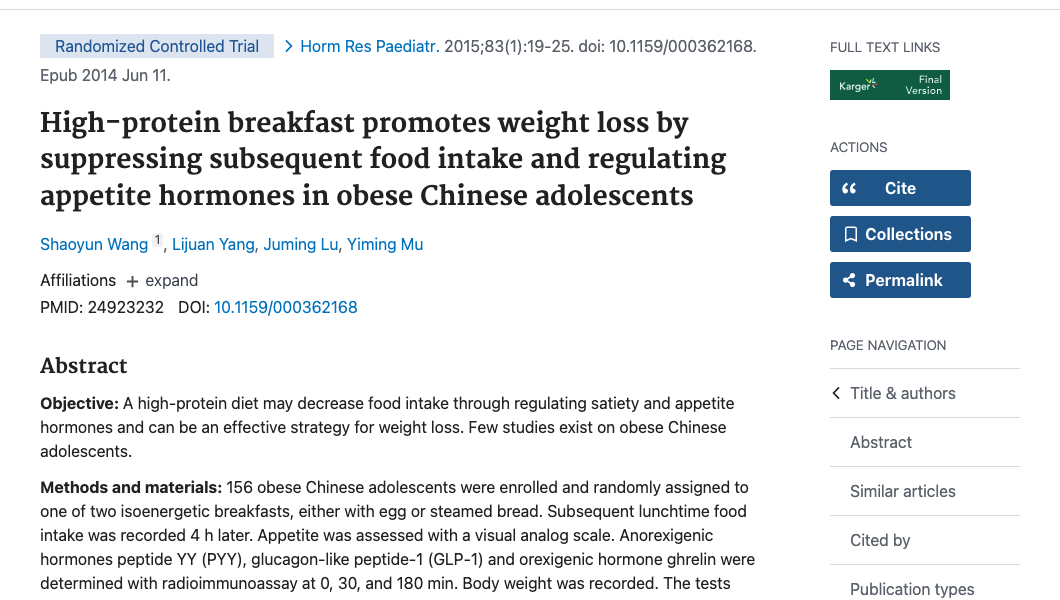
A 3-month RCT in 156 obese adolescents found that high-protein egg breakfasts reduced subsequent food intake, increased satiety hormones (PYY, GLP-1), and promoted greater weight loss compared to carb-heavy breakfasts.
Summary
This randomized controlled trial examined whether a high-protein breakfast could promote weight loss in obese adolescents over 3 months. One hundred and fifty-six obese Chinese adolescents were randomized to either a high-protein egg breakfast group or a control group consuming steamed bread (carbohydrate-heavy) breakfasts. Researchers measured subsequent food intake at lunch (4 hours later), appetite sensations, body weight, and appetite-regulating hormones at baseline and follow-up.
The high-protein breakfast group showed reduced lunchtime food intake and greater weight loss over the 3-month period. Satiety hormones PYY and GLP-1 were significantly elevated in the egg breakfast group (p < 0.001), while the hunger hormone ghrelin showed corresponding changes. Strong correlations were found between weight loss, appetite suppression, reduced subsequent food intake, and changes in appetite hormones.
This study is particularly relevant to the 30/30/30 rule because it demonstrates that the protein-first breakfast component can produce meaningful weight loss over months, not just acute appetite suppression. The mechanism works through hormonal regulation of satiety (PYY, GLP-1), which reduces total daily calorie intake without conscious restriction.
Methods
- Randomized controlled trial over 3 months
- 156 obese Chinese adolescents randomly assigned to two groups
- High-protein group: egg-based breakfasts; Control group: steamed bread breakfasts
- Subsequent food intake measured at lunch (4 hours post-breakfast)
- Appetite assessed via visual analog scale
- Appetite hormones (PYY, GLP-1, ghrelin) measured via radioimmunoassay at 0, 30, and 180 minutes
- Body weight measured at baseline and follow-up
- Pearson's correlation analysis for associations between hormones, appetite, and weight
Key Results
- High-protein breakfast group had reduced lunchtime food intake compared to control
- Greater weight loss in the egg breakfast group over 3 months
- Serum PYY and GLP-1 significantly increased in high-protein group (p < 0.001)
- Increased satiety ratings in the high-protein condition
- Strong correlations between weight loss, appetite suppression, subsequent food intake, and appetite hormone changes
- Hormonal mechanism confirmed: protein breakfast regulates satiety through PYY and GLP-1 pathways
Limitations
- Population limited to obese Chinese adolescents; may not generalize to adults or other demographics
- Compared egg vs steamed bread, which differ in more than just protein content (fat, micronutrients)
- Did not include an exercise component (only tested breakfast protein)
- Specific protein amounts not clearly reported in grams
- Cultural dietary context may limit applicability to Western diets