
Key Takeaway
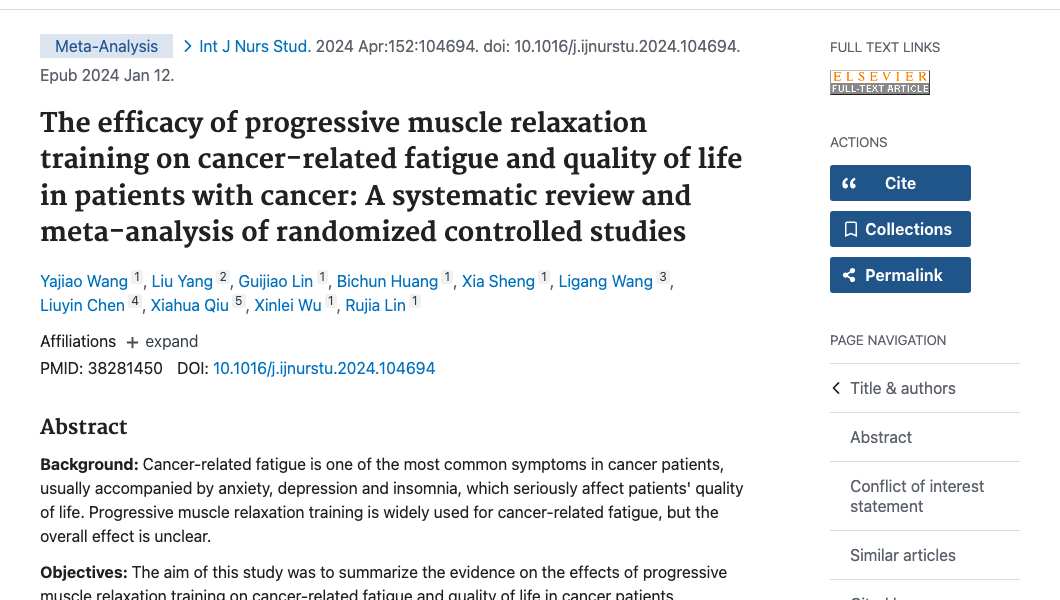
PMR significantly reduced cancer-related fatigue (SMD -0.87) and improved quality of life (SMD 0.53) across 17 RCTs with 1,564 cancer patients.
Summary
This systematic review and meta-analysis assessed the efficacy of progressive muscle relaxation (PMR) training on cancer-related fatigue (CRF) and quality of life (QoL) in patients with cancer. The authors conducted a comprehensive search of PubMed, Embase, Cochrane Library, Web of Science, CINAHL, and other databases for randomized controlled trials.
Seventeen RCTs involving 1,564 cancer patients were included. The pooled analysis demonstrated that PMR significantly reduced cancer-related fatigue (SMD -0.87, 95% CI: -1.17 to -0.57, p < 0.001) and improved quality of life (SMD 0.53, 95% CI: 0.26 to 0.80, p < 0.001) compared to control groups. Subgroup analyses revealed that PMR was effective across different cancer types and treatment phases.
The findings provide strong evidence that PMR is a beneficial complementary therapy for managing fatigue and improving quality of life in cancer patients. The authors recommend incorporating PMR into routine cancer care as a low-cost, non-invasive intervention that patients can practice independently.
Methods
Systematic review and meta-analysis of RCTs following PRISMA 2020 guidelines. Searched PubMed, Embase, Cochrane Library, Web of Science, CINAHL, and Chinese databases. Included 17 RCTs with 1,564 cancer patients. Risk of bias assessed using the Cochrane RoB 2 tool. Random-effects model used for pooled effect estimates. Subgroup and sensitivity analyses performed.
Key Results
PMR significantly reduced cancer-related fatigue (SMD -0.87, 95% CI: -1.17 to -0.57, p < 0.001) and improved quality of life (SMD 0.53, 95% CI: 0.26 to 0.80, p < 0.001). Effects were consistent across cancer types (breast, lung, colorectal) and treatment phases (during chemotherapy, post-treatment). Moderate to high heterogeneity observed across studies.
Limitations
Moderate to high heterogeneity across included studies. Variation in PMR protocols including session duration (15-30 minutes), frequency, and intervention period. Most studies had small sample sizes. Blinding of participants and personnel was not possible due to the nature of the intervention. Some included studies had high risk of bias. Publication bias was detected for some outcomes.