
Key Takeaway
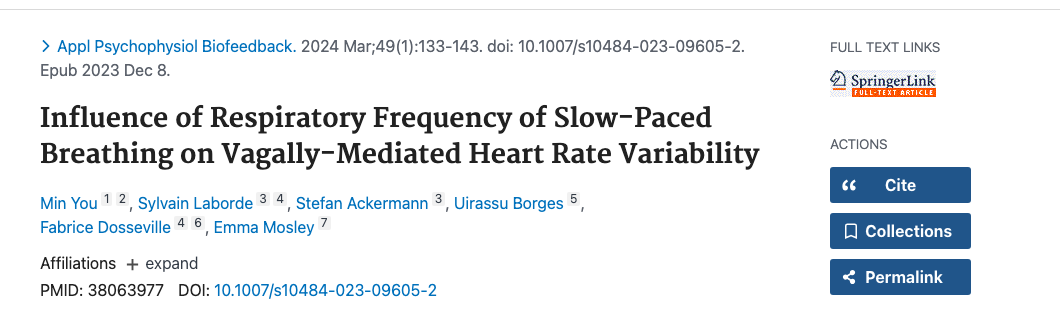
Slow-paced breathing at 5-7 cycles per minute significantly increased cardiac vagal activity in athletes compared to spontaneous breathing, with no single frequency proving clearly superior.
Summary
This study investigated whether the specific respiratory frequency of slow-paced breathing (SPB) affects its ability to increase cardiac vagal activity (CVA), a key mechanism through which breathwork improves stress management and emotional regulation. While slow breathing is known to enhance vagal tone, the optimal breathing rate had not been clearly established.
Seventy-five athletes participated in a single lab session where they performed six breathing exercises: slow-paced breathing at five different frequencies (5, 5.5, 6, 6.5, and 7 cycles per minute) and a control condition of spontaneous breathing. Heart rate variability was measured throughout as an index of cardiac vagal activity.
All five slow-paced breathing frequencies significantly increased CVA compared to spontaneous breathing, as measured by both RMSSD and low-frequency HRV (LF-HRV). Interestingly, LF-HRV was more sensitive than RMSSD in differentiating between the specific breathing frequencies. No single frequency within the 5-7 cpm range emerged as clearly superior.
These findings confirm that slow-paced breathing across a range of frequencies effectively increases vagal tone and support the practical application of SPB as a brief, accessible tool for athletes to use during competition and training. The results suggest that the exact breathing rate matters less than simply slowing breathing below the typical resting rate of 12-20 breaths per minute.
Methods
Within-subjects design with 75 athletes (22 female, mean age 22.32 years). Each participant performed six 5-minute breathing exercises in a single lab session: slow-paced breathing at 5, 5.5, 6, 6.5, and 7 cycles per minute (cpm), plus spontaneous breathing as a control. HRV was measured using RMSSD (time domain) and LF-HRV in ms² (frequency domain) as indices of cardiac vagal activity.
Key Results
- All SPB conditions (5-7 cpm) significantly increased CVA vs. spontaneous breathing
- Both RMSSD and LF-HRV (ms²) were significantly higher during all SPB conditions compared to control
- LF-HRV was more sensitive in differentiating between specific breathing frequencies than RMSSD
- No single SPB frequency was clearly superior across all metrics
- 5 minutes of practice was sufficient to produce significant effects
Limitations
- Single-session design — no assessment of chronic effects from regular practice
- Athletes only — may not generalize to sedentary or clinical populations
- Lab setting may not reflect real-world competitive scenarios
- No assessment of psychological outcomes (mood, anxiety, perceived stress)
- Within-subjects design may introduce order effects despite counterbalancing
- Only HRV measured as a proxy for vagal activity — no direct vagal nerve measurement