Key Takeaway
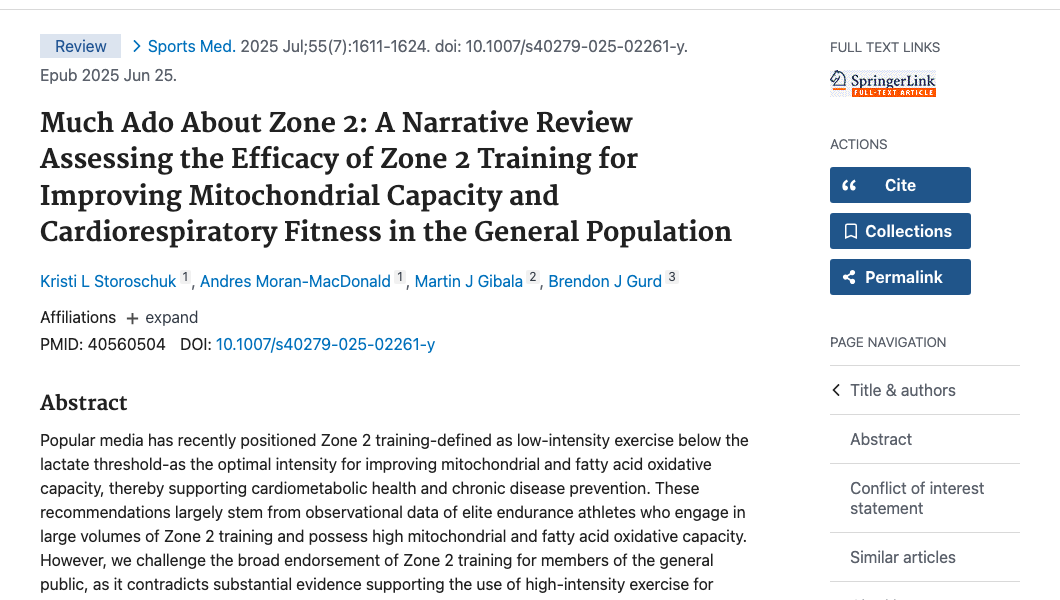
Current evidence does not support Zone 2 as the uniquely optimal intensity for mitochondrial or fatty acid oxidative capacity; higher intensities may be critical for maximizing cardiometabolic benefits, especially at lower training volumes.
Summary
This 2025 narrative review critically examines the popular claim that Zone 2 training is the optimal exercise intensity for improving mitochondrial capacity and fat oxidation. The authors systematically evaluate the physiological rationale behind Zone 2 prescriptions and compare the evidence for moderate-intensity continuous training against higher-intensity alternatives.
The review concludes that while Zone 2 training is accessible and effective for building aerobic base and supporting metabolic health, the scientific literature does not single it out as superior to other intensities for mitochondrial biogenesis or fatty acid oxidative capacity. Higher exercise intensities appear to be critical for maximizing cardiometabolic adaptations, particularly when training time is limited.
The authors recommend a balanced approach that includes both moderate and higher-intensity training rather than exclusive reliance on Zone 2 work. This nuanced perspective challenges the popular narrative that Zone 2 alone is sufficient for optimal metabolic health.
Methods
Narrative review of published literature on exercise intensity and mitochondrial adaptation. Examined studies comparing Zone 2 (moderate-intensity continuous training) with higher-intensity approaches including HIT and SIT. Evaluated evidence for mitochondrial biogenesis, fatty acid oxidation, VO2max improvements, and overall cardiometabolic outcomes across different training intensities and volumes.
Key Results
- Zone 2 training alone is not supported as the optimal intensity for mitochondrial or fatty acid oxidative capacity
- Higher exercise intensities produce greater per-session mitochondrial and cardiorespiratory adaptations
- At lower training volumes, higher intensity may be especially important for maximizing benefits
- Combined moderate and high-intensity approaches outperform Zone 2-only protocols for most outcomes
- Zone 2 remains valuable for aerobic base building, recovery, and accessibility
Limitations
- Narrative review methodology (not systematic with formal inclusion/exclusion criteria)
- Did not perform quantitative pooling or meta-analysis of effect sizes
- May not capture all relevant literature due to non-systematic search
- Training volume and intensity are difficult to equate across studies
- Limited long-term data comparing Zone 2-only versus mixed-intensity programs
Related Interventions
Related Studies
Discussed In