
Key Takeaway
77% of patients using inversion therapy avoided surgery compared to 22% in the control group, demonstrating significant potential for inversion in disc herniation treatment
Summary
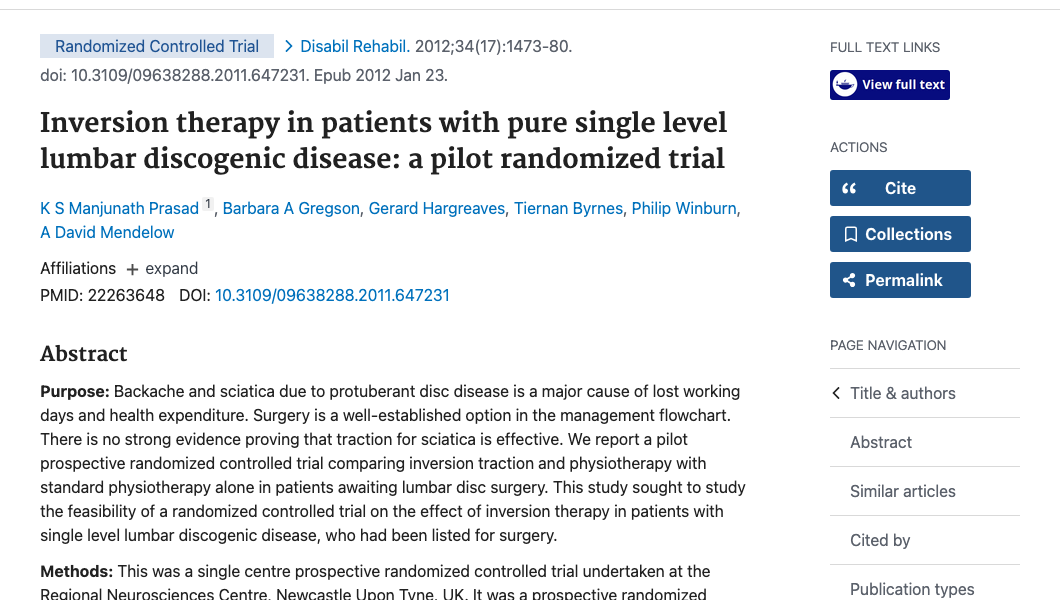
This landmark Newcastle University study randomized patients with lumbar disc herniation scheduled for surgery to either inversion therapy plus physiotherapy or physiotherapy alone. The inversion group showed dramatically reduced need for surgery, suggesting inversion therapy should be considered before surgical intervention.
Methods
- Design: Randomized controlled trial
- Participants: 24 patients with single-level lumbar disc herniation
- All patients were scheduled for surgery
- Intervention group: Inversion therapy + standard physiotherapy
- Control group: Standard physiotherapy only
- Inversion protocol: Progressive angles, regular sessions over 6 weeks
- Primary outcome: Need for surgery at 6 weeks
Key Results
- Surgery avoided in inversion group: 77% (10 of 13 patients)
- Surgery avoided in control group: 22% (2 of 11 patients)
- Absolute risk reduction: 55%
- Number needed to treat: 1.8 (treat 2 patients to avoid 1 surgery)
- No serious adverse events in inversion group
- Both groups received standard physiotherapy
- Results statistically significant (p < 0.01)
Limitations
- Small sample size (24 patients)
- Single center study
- Short follow-up period (6 weeks primary)
- Cannot blind patients to treatment
- Specific to single-level disc disease
- Selection bias possible
- Long-term durability unknown