
Key Takeaway
Early research demonstrated measurable physiological changes during inversion including decreased EMG activity in paraspinal muscles and increased intervertebral separation
Summary
This foundational study measured physiological changes during inversion therapy, documenting decreased paraspinal muscle activity and increased intervertebral space. Results provided early scientific evidence for the mechanism of action and clinical benefits of inversion therapy.
Methods
- Design: Observational physiological study
- Participants: Adults with and without back pain
- Measurements: EMG of paraspinal muscles
- Imaging: Intervertebral space measurements
- Protocol: Various inversion angles tested
- Timepoints: Before, during, and after inversion
Key Results
- Significant decrease in paraspinal EMG activity
- Measurable increase in intervertebral space
- Effects proportional to inversion angle
- Maximum effect at full inversion (90°)
- Muscle relaxation persisted after returning upright
- Pain relief correlated with EMG reduction
- No significant adverse effects documented
Figures
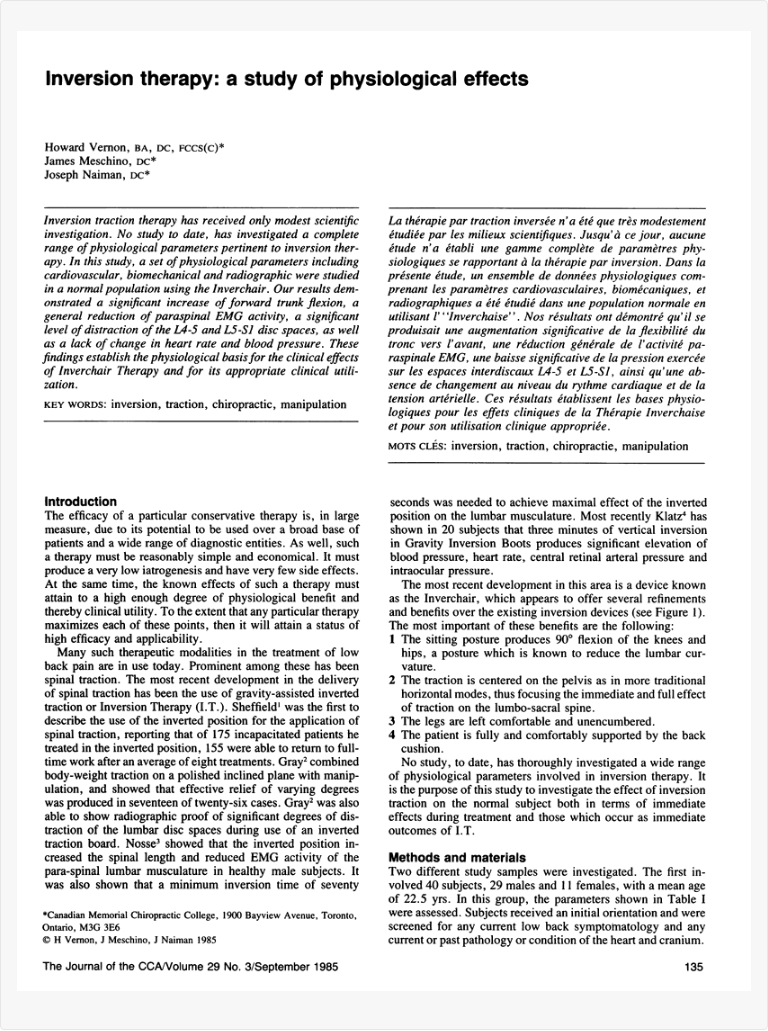 Figure 1
Limitations
- Early study methodology
- Small sample size
- Short-term measurements only
- Observational design
- Limited imaging technology of the era
- No long-term follow-up
- Potential selection bias