
Key Takeaway
Theta burst stimulation (TBS) shows equivalent efficacy to standard repetitive TMS for depression, with a better safety profile and dramatically shorter treatment times.
Summary
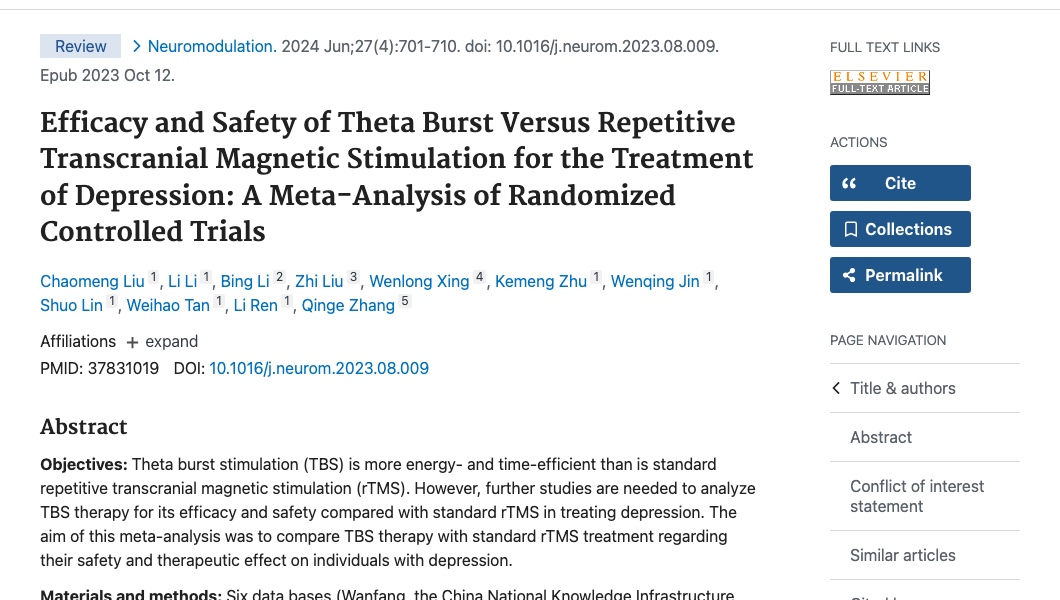
This meta-analysis directly compared theta burst stimulation (TBS) protocols to conventional repetitive transcranial magnetic stimulation (rTMS) for treating depression. The goal was to determine whether the faster TBS approach could match the established efficacy of standard rTMS while offering practical advantages.
TBS delivers magnetic pulses in rapid bursts, allowing a full treatment session to be completed in about 3-10 minutes compared to 20-40 minutes for standard rTMS. This time efficiency is what makes accelerated protocols like the Stanford SAINT approach feasible, as patients can receive multiple TBS sessions per day.
The analysis found that TBS achieved comparable antidepressant effects to rTMS with similar response and remission rates. Importantly, TBS showed a favorable safety profile with potentially lower rates of certain side effects, supporting its use as a replacement for longer conventional protocols.
Methods
- Systematic review of RCTs comparing TBS to rTMS for depression
- Included studies with patients diagnosed with major depressive disorder
- Primary outcomes: response rate, remission rate, depression scale changes
- Secondary outcomes: dropout rates, adverse events
- Random-effects meta-analysis with risk ratio calculations
- Subgroup analyses by TBS type and treatment parameters
Key Results
- No significant difference in response rates between TBS and rTMS (comparable efficacy)
- Remission rates similar between the two approaches
- TBS sessions approximately 10x faster than standard rTMS
- Similar or slightly better tolerability with TBS
- Dropout rates comparable between groups
Limitations
- Limited number of head-to-head trials available
- Heterogeneity in TBS and rTMS protocols used
- Most studies used non-accelerated (once-daily) protocols
- Short follow-up periods in many studies
- Potential differences in patient populations across trials