Summary
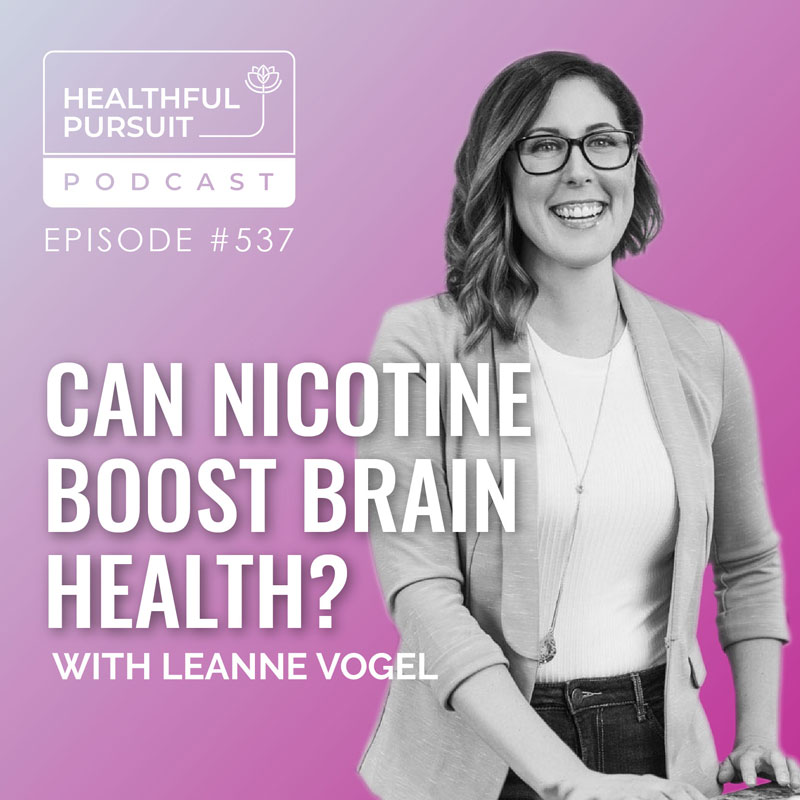
Leanne Vogel, holistic nutritionist and functional medicine practitioner, presents a solo deep-dive into nicotine as a standalone compound separate from smoking. Motivated by listener questions and her mother's Parkinson's diagnosis, she examines the research on nicotine's cognitive benefits and challenges the blanket stigma that has kept many people, especially women, from even considering it as a tool. The episode walks through nicotine's mechanism of action, explaining how it binds to nicotinic acetylcholine receptors to trigger the release of dopamine, norepinephrine, serotonin, and beta endorphins. Vogel highlights research from the Journal of Neuropharmacology showing nicotine can enhance working memory and attention in both healthy adults and those with cognitive impairments, and discusses a clinical trial demonstrating improved attention and memory in non-smoking adults with mild cognitive impairment who used transdermal nicotine patches over several months. Vogel provides practical guidance on delivery methods, ranking them from worst (smoking and vaping) to best (nicotine gum and patches), and recommends starting at extremely low doses of 0.5-1mg. She emphasizes that nicotine should only be explored after foundational health is addressed, including adequate nutrition, sleep, and stress management, and identifies specific groups who should avoid it entirely, including those with cardiovascular issues, sensitive nervous systems, addiction history, or adrenal burnout.
Key Points
- Nicotine is a naturally occurring alkaloid found in nightshade plants including tomatoes, potatoes, eggplants, and peppers, not just tobacco
- When nicotine binds to acetylcholine receptors it triggers dopamine, norepinephrine, serotonin, and beta endorphins, producing a sense of calm focus rather than a jittery caffeine-like stimulation
- A 2020 paper in Psychopharmacology found that non-smokers given low doses of nicotine showed very low potential for dependency, especially without the spike-crash pattern of cigarettes
- Nicotine may stimulate neuroplasticity, which is promising for recovery from trauma, long COVID, and chronic stress; Vogel has used cut-up nicotine patches for long COVID cases with positive results
- Clinical trials show nicotine can improve attention and memory in non-smoking adults with mild cognitive impairment, relevant to Alzheimer's prevention and age-related cognitive decline
- Recommended starting dose is 0.5-1mg via nicotine gum used 1-2 times per week, chewed once or twice then parked between cheek and gum for slow mucosal absorption
- People with cardiovascular issues, anxiety disorders, addiction history, pregnancy, or adrenal fatigue should avoid nicotine entirely
- Most nicotine research has been conducted on men, leaving significant gaps in understanding how benefits translate to women, especially during perimenopause and hormonal transitions
Key Moments
How nicotine mimics acetylcholine for learning and memory
Vogel explains that nicotine's cognitive effects come from mimicking acetylcholine, the learning and memory neurotransmitter. Acetylcholine is one of the first systems to decline in Alzheimer's, and when nicotine binds these receptors it lights up communication pathways producing enhanced focus and calm productivity.
"So, while caffeine works by blocking adenosine, nicotine's magic is how it mimics acetylcholine. So, acetylcholine is the learning and memory neurotransmitter. It's absolutely vital for cognitive function, attention, and even muscle movement."
Nicotine may stimulate neuroplasticity and help long COVID
Vogel discusses evidence that nicotine may stimulate neuroplasticity, the brain's ability to form new connections, and shares that she has used cut-up nicotine patches for long COVID recovery with positive results. A 2020 Psychopharmacology paper found very low dependency potential in non-smokers given low doses.
"So, there's also evidence that nicotine may stimulate neuroplasticity. So, this is the brain's ability to form new connections, which is especially exciting when we talk about recovery from trauma, long COVID or chronic stress. I've actually used nicotine patches cut up into little pieces for COVID recovery for long COVID cases, and I was pretty impressed"
Nicotine for ADHD and perimenopause brain fog
Vogel discusses nicotine's potential as a non-pharmaceutical option for ADHD, particularly for people who don't respond well to stimulants like Adderall or Ritalin. She connects this to the brain fog many women experience during perimenopause, suggesting nicotine could sharpen cognitive performance.
"So, nicotine is wildly known to improve attention span, task switching, sustained concentration. This is part of why it's being explored as a potential treatment for ADHD, particularly in people who don't respond well to stimulants like Adderall or Ritalin"
Practical dosing protocol for nicotine beginners
Vogel outlines a practical protocol for trying nicotine safely, recommending nicotine gum at 1mg or less, used only 1-2 times per week. She advises chewing once or twice then parking it between cheek and gum for slow mucosal absorption, and warns against pairing with caffeine.
"So you just start with one milligram or even less. And that's often a pretty high dose for somebody that's just experimenting or using it occasionally. Like I don't think we need to go over one milligram personally often."