Key Takeaway
Tobacco industry-affiliated studies were significantly more likely to report cognitive benefits of nicotine, while independent studies showed mixed results, highlighting the need to account for funding bias.
Summary
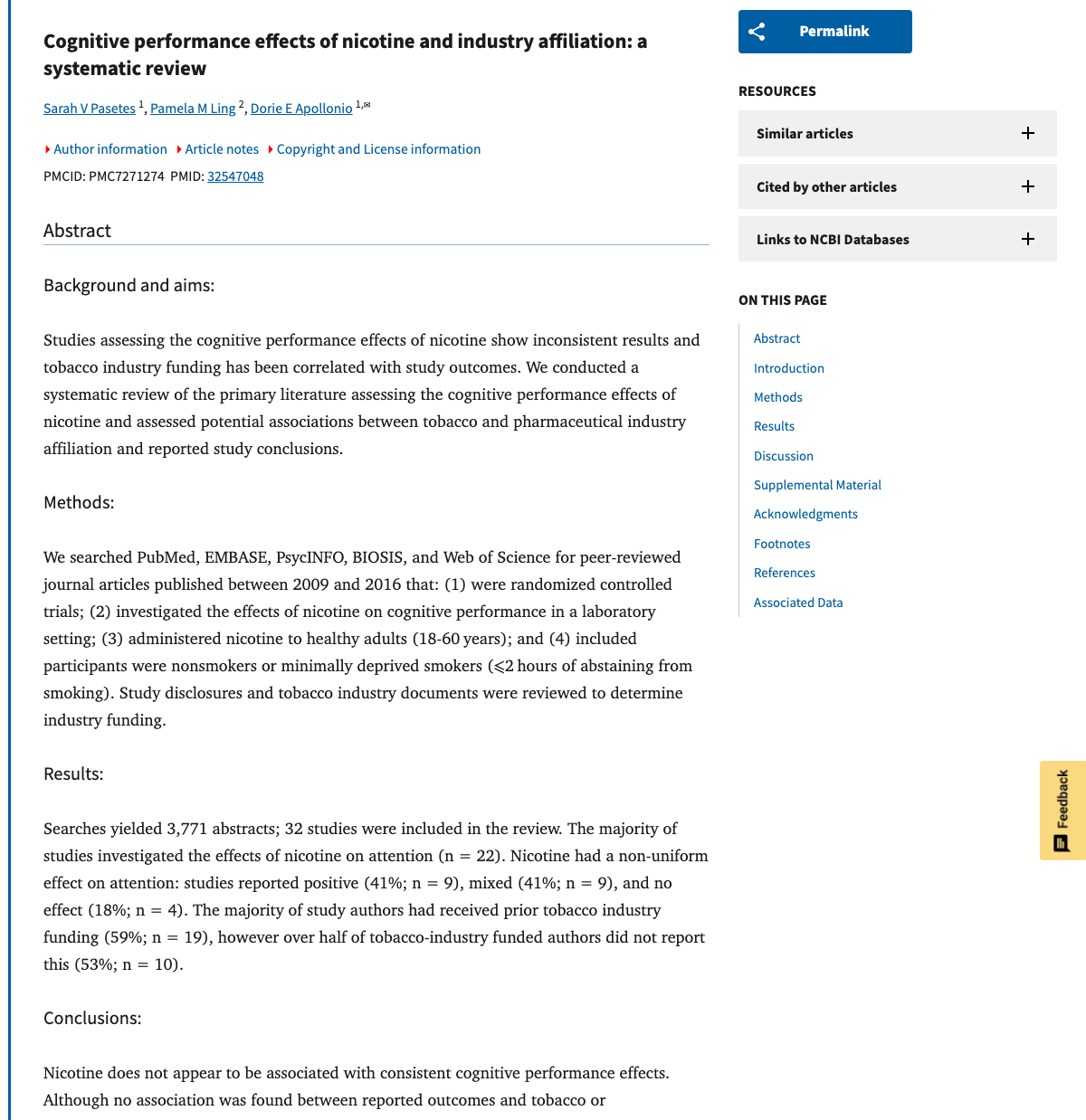
This systematic review examined the relationship between study funding source and reported cognitive effects of nicotine. The authors identified studies assessing nicotine's effects on cognitive performance and classified them by industry affiliation - whether they were funded by or had authors affiliated with the tobacco industry.
The key finding was a strong association between industry affiliation and positive results. Studies with tobacco industry ties were significantly more likely to report that nicotine improved cognitive performance. Independent studies showed more mixed and nuanced results, with some finding benefits and others finding no significant effects or even decrements in certain cognitive domains.
This review provides important context for interpreting the nicotine-cognition literature. While nicotine does appear to have genuine acute cognitive effects (particularly on attention), the magnitude and breadth of benefits may be overstated in the literature due to industry influence. The authors emphasize that funding source should be considered when evaluating evidence for nicotine as a cognitive enhancer.
Methods
Systematic search of PubMed/MEDLINE, Embase, and PsycINFO for studies assessing nicotine's effects on cognitive performance in humans. Studies were classified by industry affiliation based on funding disclosures, author affiliations, and tobacco industry document archives. Outcomes were categorized as positive (nicotine improved cognition), negative (nicotine impaired cognition), or null (no significant effect). Statistical analysis assessed the association between industry affiliation and study outcomes.
Key Results
- Industry-affiliated studies were significantly more likely to report positive cognitive effects of nicotine
- Independent studies showed more heterogeneous results across cognitive domains
- Attention was the domain most consistently showing benefits regardless of funding source
- Memory and executive function results were more variable and sensitive to funding bias
- The overall literature is substantially influenced by industry-funded research
Limitations
- Industry affiliation classification may miss undisclosed conflicts of interest
- Does not directly assess whether specific study methodologies were biased
- Cannot determine the "true" effect size independent of funding influence
- Some studies had unclear or ambiguous funding disclosures
- Review does not distinguish between different nicotine delivery methods
- Temporal trends in research funding not fully accounted for
Related Interventions
Related Studies
Discussed In