Key Takeaway
Nicotine reliably enhances attention and working memory through nicotinic acetylcholine receptor activation, with effects modulated by baseline cognitive capacity, genetics, and dosing parameters.
Summary
This comprehensive review synthesizes recent research on nicotine's cognitive effects, covering molecular mechanisms, clinical evidence, and individual difference factors that modulate response. The authors examine nicotine's actions across multiple cognitive domains including attention, working memory, episodic memory, and executive function.
The review establishes that nicotine's cognitive effects operate primarily through activation of nicotinic acetylcholine receptors (nAChRs), particularly the alpha-4-beta-2 and alpha-7 subtypes. These receptors modulate the release of multiple neurotransmitters including dopamine, norepinephrine, and glutamate, creating a broad neurochemical basis for cognitive enhancement. The authors present a bivalent model where nicotine's effects follow an inverted-U dose-response curve - too little produces no effect, moderate doses optimize cognition, and high doses impair performance.
Key moderating factors identified include baseline cognitive performance (those with lower baseline tend to show greater improvement), genetic polymorphisms in cholinergic and dopaminergic systems, age, and smoking status. The review also discusses implications for clinical populations, noting that nicotine shows particular promise for conditions involving cholinergic deficits such as Alzheimer's disease, schizophrenia, and ADHD.
The authors conclude that while nicotine's attention and working memory benefits are well-established, the field still needs better characterization of individual differences in response, optimal dosing parameters, and long-term safety data for non-therapeutic use.
Methods
Narrative review of recent literature on nicotine's cognitive effects in humans. Searched PubMed and PsycINFO for studies published through 2017 examining nicotine administration and cognitive performance. Covered both preclinical mechanism studies and human clinical trials. Organized findings by cognitive domain (attention, working memory, episodic memory, executive function) and by moderating variables.
Key Results
- Attention: Most robust and consistent benefit, documented across smokers and non-smokers
- Working memory: Significant improvements, particularly on tasks with higher cognitive load
- Episodic memory: Mixed results; some improvement in encoding, less consistent for retrieval
- Executive function: Variable effects depending on specific task demands
- Dose-response follows inverted-U curve - moderate doses optimal, high doses can impair
- Baseline cognitive capacity moderates effects - those with lower baseline show greater gains
- Genetic variation in nAChR and dopamine receptor genes influences individual response
Figures
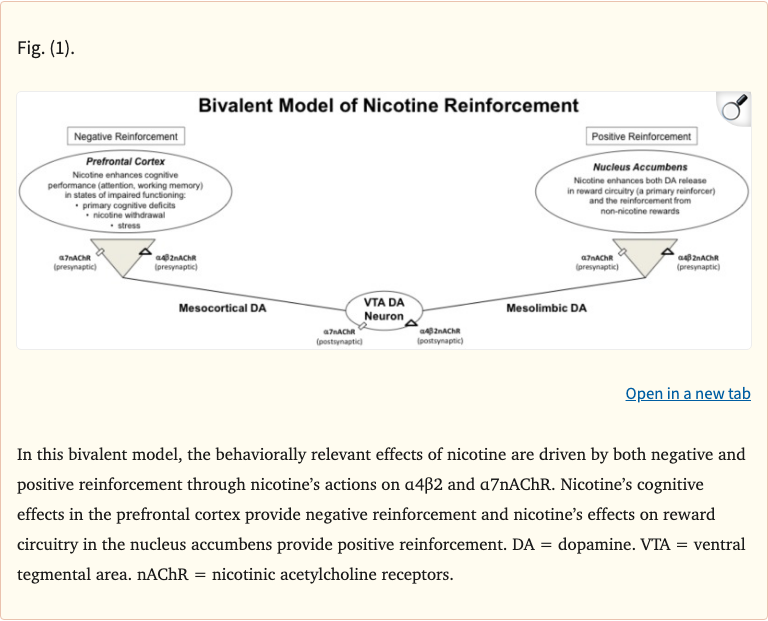 Figure 1
Limitations
- Narrative rather than systematic review, limiting reproducibility of literature selection
- Most cited studies used short-term nicotine administration protocols
- Limited data on chronic low-dose nicotine in healthy non-smokers
- Difficulty separating nicotine's direct cognitive effects from arousal and mood effects
- Individual difference factors are identified but not yet sufficient for personalized prediction
- Translational gap between receptor-level mechanisms and real-world cognitive performance
Related Interventions
Related Studies
Discussed In